 We’ve secured funding to power Signal-to-Revenue AI to GTM teams globally. →
A CNAME Record (Canonical Name record) is a DNS record that maps one hostname (an alias) to another hostname ...
Subscribe Now
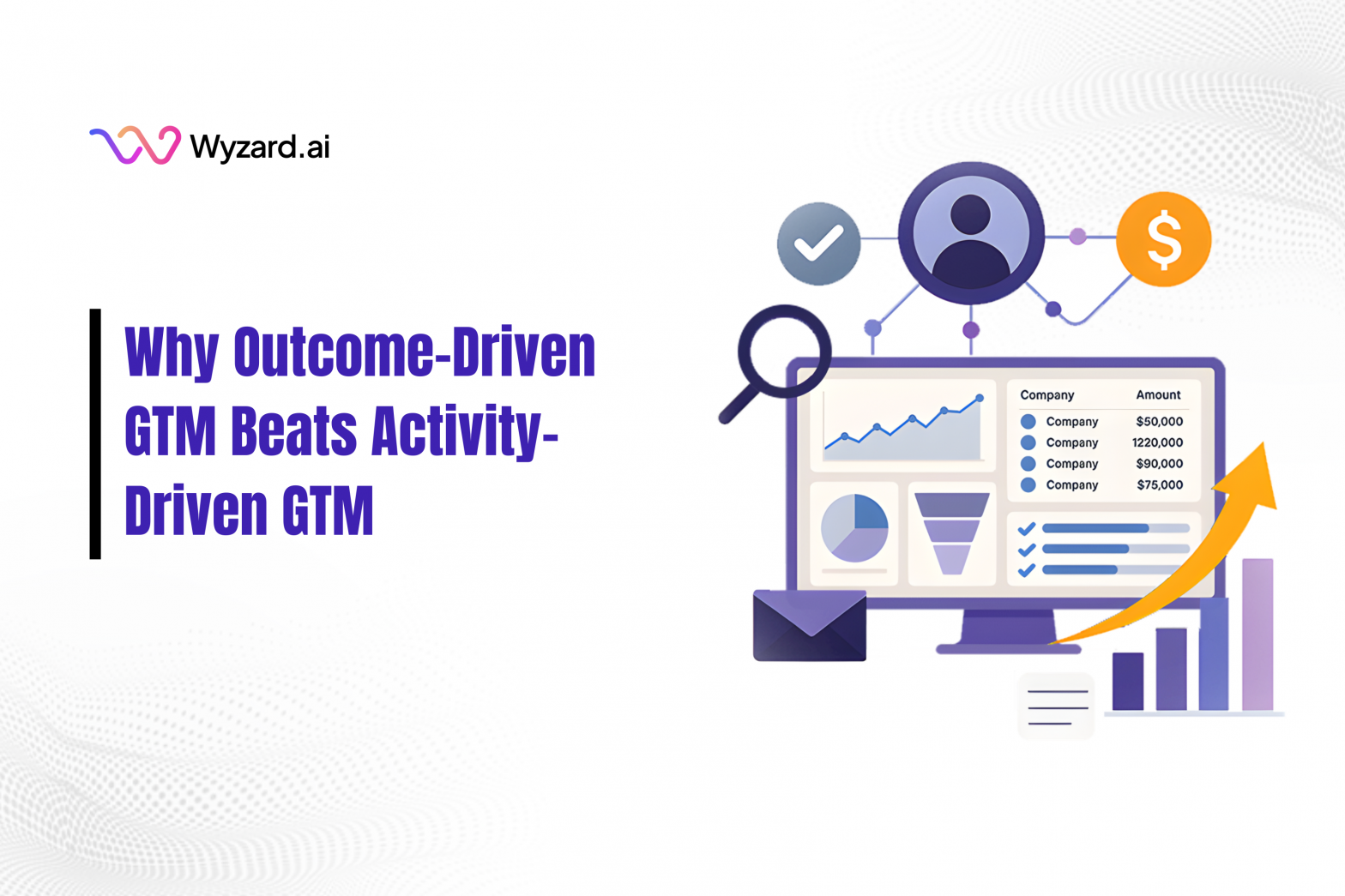
Teams often measure progress by how much activity they produce — outbound volume, campaign touches, tasks completed, sequences launched. At a glance, these metrics look encouraging. Plenty of motion. Plenty of output. Plenty of dashboards trending upward.
But leaders know the uncomfortable reality – Activity doesn’t guarantee outcomes.
This disconnect is widening across modern GTM teams. More tasks, yet unpredictable revenue. More tools, yet unclear progress. More dashboards, yet less confidence in the path forward.
The shift underway is simple. Teams are moving from an activity-driven GTM model to an outcome-driven one. And the teams making this shift are seeing clearer alignment, stronger ROI, and more reliable revenue patterns, powered by Wyzard, the Signal-to-Revenue AI.
Activity Volume Creates a False Sense of Progress
Activity-heavy GTM engines look productive on paper. But activity can disguise inefficiency. Rarely a GTM activity directly contributes to revenue outcomes, with most tasks failing to influence actual deal movement. This is the core issue. Activity signals effort. Outcomes signal impact.
In an activity-driven model:
- Teams chase volume instead of progress
- Reps execute tasks that don’t reflect buyer intent
- Leaders manage dashboards instead of momentum
- “More messaging” gets mistaken for “more revenue”
These engines move quickly, but often in the wrong direction, and without the structural clarity needed to adapt.
Outcome-Driven GTM Starts With Clarity, Not Volume
Outcome-driven teams begin with a different question:
What result are we trying to create?
This is the heart of the Activity vs Outcomes distinction.
Outcome-driven GTM:
- Defines a clear intention (meetings, expansions, retention, activation)
- Aligns every campaign or motion to that intention
- Responds to buyer behavior the moment it appears
- Measures success based on movement, not messages
This approach increases GTM efficiency because teams stop spending energy on work that doesn’t contribute to progress.
Wyzard.ai’s WyzGoal provides the anchor, the declaration of the outcome the system is trying to achieve. Every signal, every touchpoint, and every AI-driven action flows from this single source of truth. This is a true Signal-to-Revenue AI.
For paid programs, the same mindset applies—optimize for paid media success beyond clicks by designing journeys that turn intent into meetings and revenue: paid media success beyond clicks.
Why Outcome-Driven GTM Requires a System-Level View
Outcome-driven execution cannot thrive inside disconnected tools.
It requires a model that understands buyer context across multiple channels, surfaces, and behaviors.
This is where the GTM Intelligence Graph comes in.
The graph unifies:
- Identity
- Account context
- Timing
- Behavioral patterns
- Readiness signals
It gives GTM teams a shared interpretation of what matters and why. Instead of chasing every task, the team focuses on the signals that actually advance revenue.
With the help of Wyzard, the Signal-to-Revenue AI, using WyzSignals and WyzEnrich to feed the graph with high-quality data, WyzQualify to interpret buyer readiness and WyzGPT to provide reasoning to connect signals, context, and decisions, it creates the intelligence layer required to run outcomes, not tasks.
Orchestration Is What Turns Outcomes Into Motion
Once the GTM Intelligence Graph establishes meaning, the next step is directing action. This is where outcome-driven teams separate themselves from activity-heavy ones.
Legacy systems (Outreach, Salesloft) push tasks, sequences, and workflows. They move motion forward, but not necessarily progress.
Outcome-driven teams use orchestration instead. They chose Wyzard, the Signal-to-Revenue AI, a model where the system adapts execution based on:
- Outcome intention
- Buyer readiness
- Channel preference
- Real-time behavior
WyzChannels (Agentic Chat, Agentic Email, Agentic LinkedIn, Agentic Calling) allows the system to act with the right tone, timing, and context. WyzGoal ensures every action stays aligned with the team’s intended result.
This is the backbone of a System of Outcomes – a modern structure where GTM efforts no longer depend on rigid workflows but instead adapt dynamically.
Why Outcome-Driven GTM Improves ROI Alignment
ROI breaks down when teams tie success to tasks instead of outcomes. Marketing sends leads. Sales sends sequences. Ops sends dashboards. Each function pulls a different lever, but none share a unified goal.
Outcome-driven GTM creates ROI Alignment because:
- Teams measure results the same way
- Leaders see progress in revenue terms, not activity terms
- Actions reflect buyer intent, not internal checklists
- Budgets align to outcomes that matter
A recent study by Bain found that companies aligning GTM around outcomes instead of usual activity could save up to 30% improvement in revenue conversion efficiency.
Outcome clarity strengthens budgets, planning, forecasting, and accountability across the entire revenue engine.
What Powers Outcome-Driven GTM: Wyzard, The Signal-to-Revenue AI
Outcome-driven execution demands real-time alignment. Signals change quickly. Intent appears briefly. Buyers expect immediate relevance.
Human-led coordination can’t keep up.
Wyzard, the Signal-to-Revenue AI ties everything together:
- WyzSignals listens for meaningful moments
- WyzEnrich adds identity and context
- WyzQualify interprets urgency
- WyzGPT reasons across the signal landscape
- WyzGoal sets the desired outcome
- WyzChannels activates the right touch at the right moment
The result is a GTM engine that adapts instantly — not days later.
Outcome-driven GTM isn’t about replacing people. It’s about giving teams a system that reacts with precision so humans can focus on strategy, creativity, and relationships.
If You Want GTM Effort to Reflect GTM Outcomes
You don’t need more sequences. You don’t need more dashboards. You don’t need more activity to feel confident.
You need a GTM engine aligned to outcomes, guided by intelligence, and executed with precision.
Wyzard.ai provides the architecture for that shift.
Book a demo and see how Wyzard, the Signal-to-Revenue AI, helps teams move beyond activity and build a revenue engine driven by outcomes.
Other blogs
The latest industry news, interviews, technologies, and resources.
What Is A BIMI Record And How To Set It Up
A BIMI record (Brand Indicators for Message Identification) is a DNS-based email standard that can display your brand logo ...

What Is A Return-Path Record And How To Set It Up
Return-Path is an email header (and domain) that tells mail servers where bounce messages should go when an email ...
