 We’ve secured funding to power Signal-to-Revenue AI to GTM teams globally. →
A CNAME Record (Canonical Name record) is a DNS record that maps one hostname (an alias) to another hostname ...
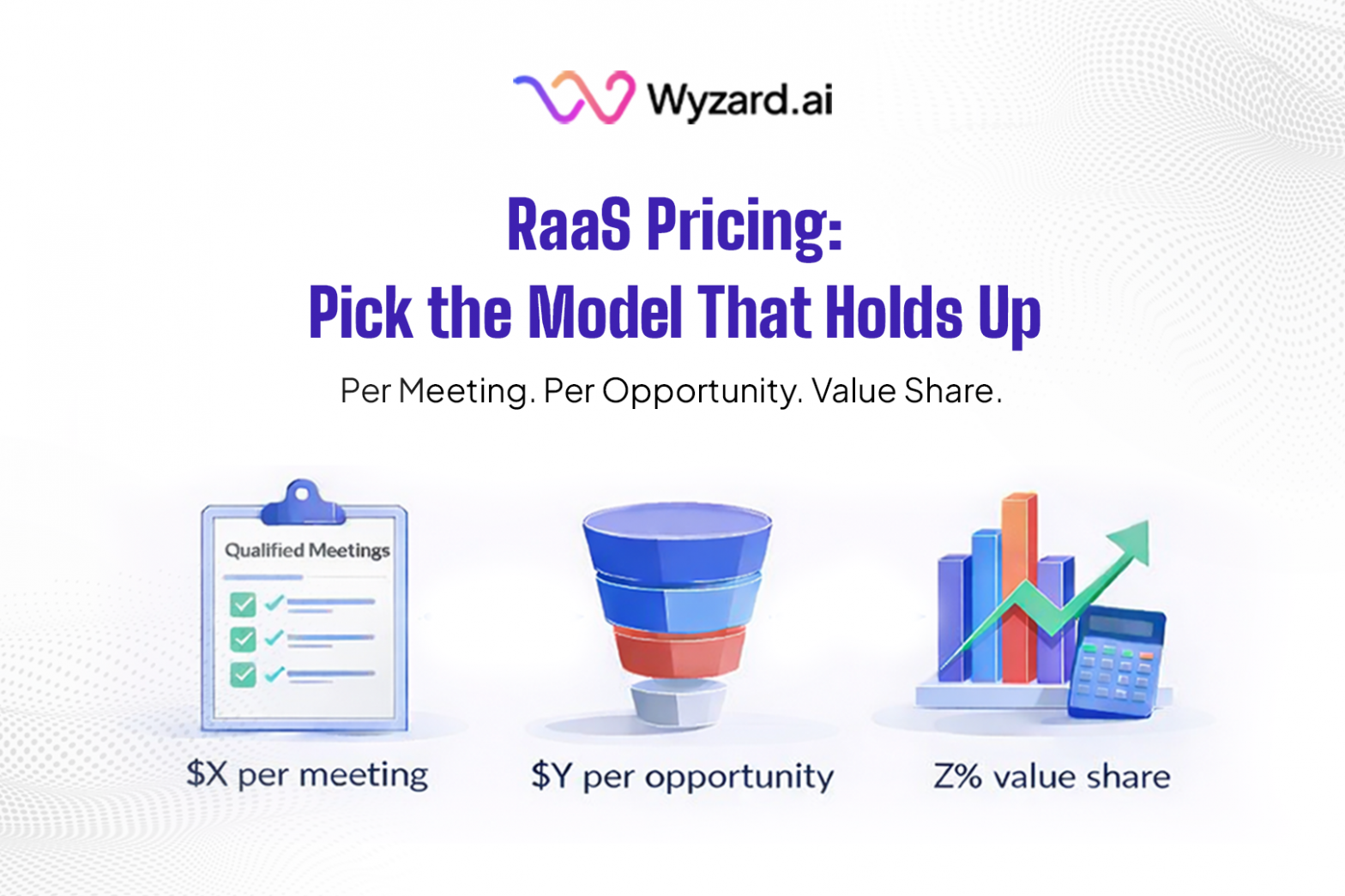
Results as a Service (RaaS) Pricing Models for GTM: Per Meeting, Per Opportunity, or Value Share?
Published
Categorized as Uncategorized
Subscribe Now
Your CEO asks the question every CMO knows is coming: “We invested in demand. What did we actually buy?”
You can list the activity: event scans, webinar registrations, LinkedIn ad clicks, website visits, nurture replies. The harder part is pricing outcomes in a way Finance will approve and Sales will accept.
That is why Results as a Service (RaaS) pricing matters. It shifts GTM spend from tools to outcomes, and it only works when definitions and attribution are tight. Wyzard, the Signal-to-Revenue AI, orchestrates every signal into revenue by capturing intent across channels and triggering timely follow-up with traceable execution.
Why Pricing Becomes the Real Debate
In Results as a Service (RaaS), pricing is more than a number. It is risk allocation.
- Who owns execution risk?
- Who owns measurement risk?
- What happens when Sales rejects meetings?
- What happens when attribution fields are missing?
This is where outcome-based pricing and pay for performance can create clean alignment, or create a monthly argument. The difference is definition, auditability, and a clear explanation of what happened and why.
Two capabilities decide whether RaaS pricing scales:
- ROI Measurement for AI that Finance can trust
- Agent Observability that RevOps can audit
Lock the Measurement Layer Before You Talk Numbers
Pricing works when results are defined like contract terms. A “qualified meeting” needs ICP, persona, intent, and held status rules. An “opportunity created” needs stage definitions, required fields, and dedupe logic. “Influenced pipeline” needs time windows and source-of-truth fields.
Clear rules make the model run. The GTM Intelligence Graph provides unified context across signals, and the System of Outcomes keeps definitions consistent so outcomes stay measurable across channels.
The 3-Model Framework for Results as a Service (RaaS) Pricing
Here are the three most common pricing models CMOs evaluate, with placeholders for numbers and a view on fit.
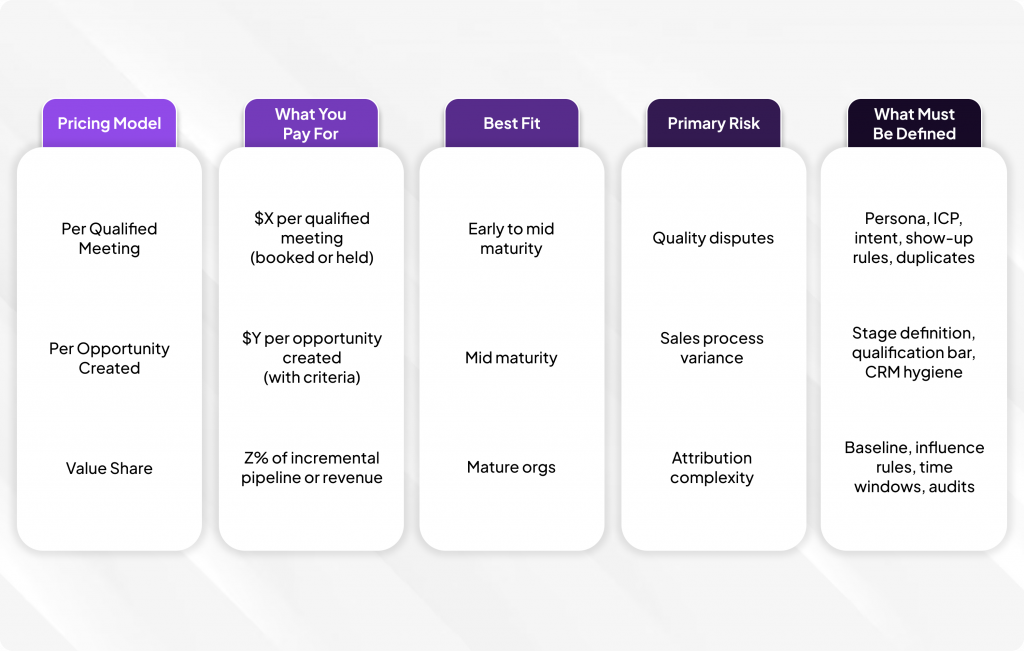
Each model can work inside RaaS. The right choice depends on your GTM maturity and your willingness to standardize measurement.
Model 1: Per Qualified Meeting
This is often the cleanest entry point into Results as a Service (RaaS). You pay for meetings that match your rules.
How it works:
- Price placeholder: $X per qualified meeting held
- Optional split: $X per booked, $Y per held
Why teams pick it:
- Simple budgeting
- Fast feedback loop
- Clear tie to early pipeline outcomes
Where it breaks:
- Quality disputes when “qualified” is vague
- Volume incentives when exclusions are missing
What to lock before launch:
- ICP and persona rules
- Intent threshold tied to real signals (event scan plus webinar attended, LinkedIn click plus pricing revisit, nurture reply from a high-fit account)
- Dedupe logic by account and contact
- Held meeting policy, no-show treatment, reschedule window
Clear rules make this model a strong pilot for CMOs who want predictable output without complex attribution.
Model 2: Per Opportunity Created
This model brings Results as a Service (RaaS) closer to Sales reality. You pay when an opportunity is created and meets defined criteria.
How it works:
- Price placeholder: $Y per opportunity created that meets qualification rules
- Optional bonus: $Y plus bonus at defined stage progression
Why teams pick it:
- Stronger alignment with Sales quality expectations
- Fewer “meetings that go nowhere”
- Better input for forecasting
Where it breaks:
- Variation in how opportunities get created across reps and teams
- CRM stage hygiene becomes the gating factor
- Slower feedback cycles, since opportunities take time to mature
What to lock before launch:
- Opportunity definition in CRM (required fields, stage criteria)
- Who can create an opportunity and when
- Source mapping and writeback rules
- Disqualification reasons and dedupe logic
This model fits teams with steady RevOps discipline and clear agreement on what an opportunity means.
Model 3: Value Share
Value share is the highest alignment version of Results as a Service (RaaS). It is also the hardest to measure cleanly.
How it works:
- Price placeholder: Z% of incremental pipeline sourced, measured quarterly
- Alternate: Z% of incremental revenue with defined attribution rules
Why teams pick it:
- Tight alignment with true business impact
- Incentives push continuous improvement across the funnel
- Less pressure to maximize volume
Where it breaks:
- Attribution disputes can overwhelm the relationship
- Baselines are hard to agree on
- Finance needs a clear audit trail
What to lock before launch:
- Baseline definition (time window, segment, channels included)
- Sourced vs influenced rules
- Time windows for influence
- Audit process and data sources of truth
Value share works best when your reporting and attribution discipline is already mature.
Picking the Right Model by GTM Maturity
A practical shortcut:
- Messy CRM hygiene: start with per qualified meeting, tighten rules, fix writeback
- Standard opportunity definitions: move to per opportunity created
- Mature attribution and baselines: value share becomes realistic
Start with one motion, then expand. A first motion can come from event leads and webinar attendees. Another motion can come from paid demand and website intent. A third motion can come from multi-channel ABM across a buying committee.
Where Wyzard.ai Makes Results as a Service (RaaS) Pricing Practical
Pricing disputes usually come from missing context and missing proof. Wyzard, the Signal-to-Revenue AI, connects your buyer signals across channels and turns them into tracked actions, so outcomes can be priced with clarity.
Under the hood, the GTM Intelligence Graph ties together signals from events, webinars, paid, website intent, LinkedIn engagement, and nurture replies. The System of Outcomes keeps definitions and exclusions consistent. AI GTM Engineers execute with human oversight, so delivery stays measurable and auditable as volume scales.
That is the difference between pricing a promise and pricing a system.
Common Pitfalls to Avoid
- Paying for booked meetings without a held and qualified rule set
- Paying per opportunity without a strict opportunity definition
- Value share without an agreed baseline and influence window
- Missing exclusions for duplicates, wrong personas, or no-shows
- No weekly audit rhythm between Marketing, Sales, and RevOps
If you want Results as a Service (RaaS) to feel predictable, treat definitions and measurement as the product. Choose a pricing model that matches your maturity.
A Practical Next Step
If you are evaluating Results as a Service (RaaS) pricing for GTM, start by choosing one motion and one outcome. Pick the model that fits your current data discipline.
Book a demo with Wyzard.ai. We will map your highest-value signals, from event scans and webinar attendance to LinkedIn ad clicks, website intent, and nurture replies, into a measurable outcome. Then we will help you pick the right RaaS pricing model with definitions your Finance and RevOps teams can sign off on.
Other blogs
The latest industry news, interviews, technologies, and resources.
What Is A BIMI Record And How To Set It Up
A BIMI record (Brand Indicators for Message Identification) is a DNS-based email standard that can display your brand logo ...

What Is A Return-Path Record And How To Set It Up
Return-Path is an email header (and domain) that tells mail servers where bounce messages should go when an email ...
