 We’ve secured funding to power Signal-to-Revenue AI to GTM teams globally. →
A CMO reviews the weekly pipeline report and sees all the expected activity. A target account visited the website. ...
Enterprise ABM Signal Noise: How to Prioritize Buying Signals That Actually Matter
Published
Categorized as Uncategorized
Subscribe Now
If you are a CMO running enterprise ABM, the problem is rarely a lack of activity. It is an overload of disconnected signals. A lead gets scanned at an event, another clicks a LinkedIn ad, a target account attends your webinar, someone replies to a nurture email, and a few anonymous visitors land on your pricing page. Everything looks urgent, yet very little turns into revenue. That is why ABM signal prioritization matters so much. Recent 2025 B2B SaaS funnel benchmarks place average MQL-to-SQL conversion at 15% – 21%, which means most “qualified” volume still never becomes real sales action.
This gap is what Wyzard.ai is built to solve. It is the Signal-to-Revenue AI and an AI GTM orchestration platform for marketing, sales, growth, and RevOps teams. It captures live activity across web, email, LinkedIn, CRM, events, and webinars, then turns that activity into coordinated next steps through WyzSignals, WyzEnrich, WyzGoal, WyzChannels, and omni-channel agentic execution with human oversight. In practice, Wyzard.ai helps teams move from scattered activity to ABM signal prioritization tied to pipeline.
Why ABM signal prioritization has become a CMO issue
Picture a CMO at a fast-growing SaaS company walking into a Monday pipeline review. Paid campaigns are producing names. Events are generating scans. Webinar attendance looks healthy. SDRs are busy. Then the team tries to answer one simple question: which accounts deserve immediate attention right now? The room gets quiet. The team has dashboards, but not clarity.
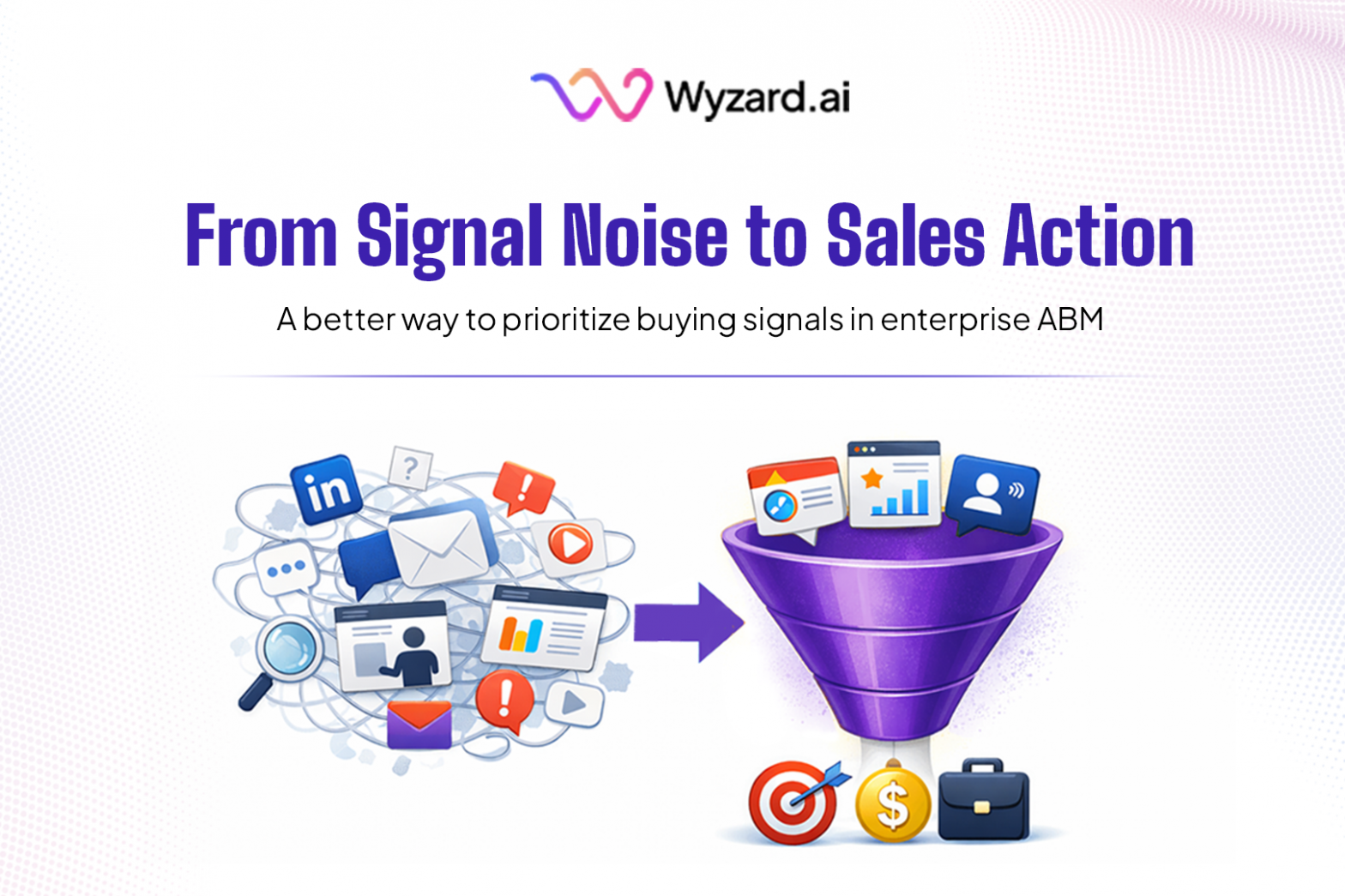
That is what signal noise looks like in practice. Buying signals are coming in, yet they are not ranked in a way that reflects account fit, timing, channel context, or buying-stage relevance. One webinar registration from a low-fit account should not outrank repeated pricing-page visits, a nurture reply, and product-page engagement from a target account. Without ABM signal prioritization, teams confuse activity with intent and motion with progress.
The fix starts by treating signal review as a revenue decision, rather than a reporting exercise. Strong ABM signal prioritization asks four questions in sequence. Is this the right account? Is the behavior meaningful? Is the timing fresh enough to matter? Is there enough context to act with confidence? This is where intent data, signal scoring, and channel-level context become useful. They should not sit in separate dashboards. They should help your team identify real in-market accounts before the moment passes.
What strong ABM signal prioritization looks like
Strong ABM signal prioritization does not begin with volume. It begins with fit. A CMO does not need every lead surfaced faster. A CMO needs the right accounts surfaced with enough context for the next touch to feel timely and relevant.
Start with fit. Is the account inside your ICP by company size, segment, region, or tech stack? Then look at signal strength. A single ad click is interesting. A LinkedIn ad click followed by webinar attendance, a pricing-page visit, and an email reply forms a pattern. Next, check recency. Signals lose value when they sit untouched. Then review channel mix. Real buying journeys do not happen in one place. They move across events, paid media, website visits, email engagement, LinkedIn conversations, and direct outreach. Good ABM signal prioritization reads that pattern and treats it as one story, not five disconnected actions.
A simple account intelligence exercise for your next team meeting
If your team wants better ABM signal prioritization this quarter, start with one practical exercise before buying another dashboard. Pull your top 10 target accounts and review the last 14 to 30 days of activity. For each account, ask: which signals came in, from which channels, from how many people, and how recently? Then ask the harder question: would Sales know exactly why this account deserves action today?
From there, place every account into one of three buckets: Noise, Monitor, or Act Now. This is a simple account intelligence exercise, yet it forces discipline. It moves the conversation away from lead volume and closer to account readiness. It often reveals where the team is overvaluing isolated touches and undervaluing clustered intent.
How Wyzard.ai turns ABM signal prioritization into execution
This is where Wyzard.ai becomes more than another signal layer. WyzSignals captures real-time activity across first-party, second-party, and third-party sources. WyzEnrich adds firmographic, technographic, and contextual depth. WyzGoal lets teams define the revenue motion in natural language. WyzChannels coordinates agentic chat, email, and LinkedIn so the response matches the moment and the channel. Underneath it all, the GTM Intelligence Graph connects events, identities, and history into one operating view, and Agentic Memory preserves the context that usually gets lost between touches. So when someone attends a webinar, revisits your site, and replies to a nurture email a week later, Wyzard.ai can treat that as one evolving buying journey, not three unrelated alerts.
That matters since execution is where many ABM programs break. Wyzard.ai can trigger agentic chat for live qualification, agentic email for campaign follow-up and event outreach, and agentic LinkedIn for mid-funnel reactivation. It does this inside a System of Outcomes, where the goal is measurable revenue impact, not activity for activity’s sake. AI GTM Engineers help define goals, tune qualification logic, and interpret results, so the platform stays aligned with brand, pipeline, and human oversight. For CMOs, that is the difference between automation that fires and orchestration that performs.
What this means for enterprise CMOs
At the executive level, ABM signal prioritization is not an ops cleanup project. It is a growth lever. It shapes where your team spends human attention, how fast qualified interest gets a response, and whether your GTM engine behaves like a collection of tools or a coordinated revenue system. Wyzard.ai gives CMOs a way to unify signals, prioritize with context, and execute across channels with human oversight, so pipeline reviews become less about guesswork and more about control.
Enterprise ABM does not fail from lack of data. It fails when too much of that data arrives without meaning, ownership, or follow-through. ABM signal prioritization is how you separate noise from revenue opportunity. And when that process runs through Wyzard, the Signal-to-Revenue AI, with its GTM Intelligence Graph, System of Outcomes, and AI GTM Engineers, your team can turn every serious buying moment into a faster, smarter next step. Book a demo and see it in action.
Other blogs
The latest industry news, interviews, technologies, and resources.
The 5-Minute Rule for ABM: How Fast Response Turns Buyer Intent Into Pipeline
If you are a CMO running enterprise growth, you have probably seen this in a pipeline review. A target ...

Your Buyer Isn’t One Person: How to Map the Full Buying Group in Enterprise ABM
If you’re a CMO running enterprise ABM, you’ve likely seen this play out. A target account shows strong engagement. ...
