 We’ve secured funding to power Signal-to-Revenue AI to GTM teams globally. →
If you are a CMO, this situation feels familiar. Your team has a CRM, marketing automation, paid campaigns, webinars, ...
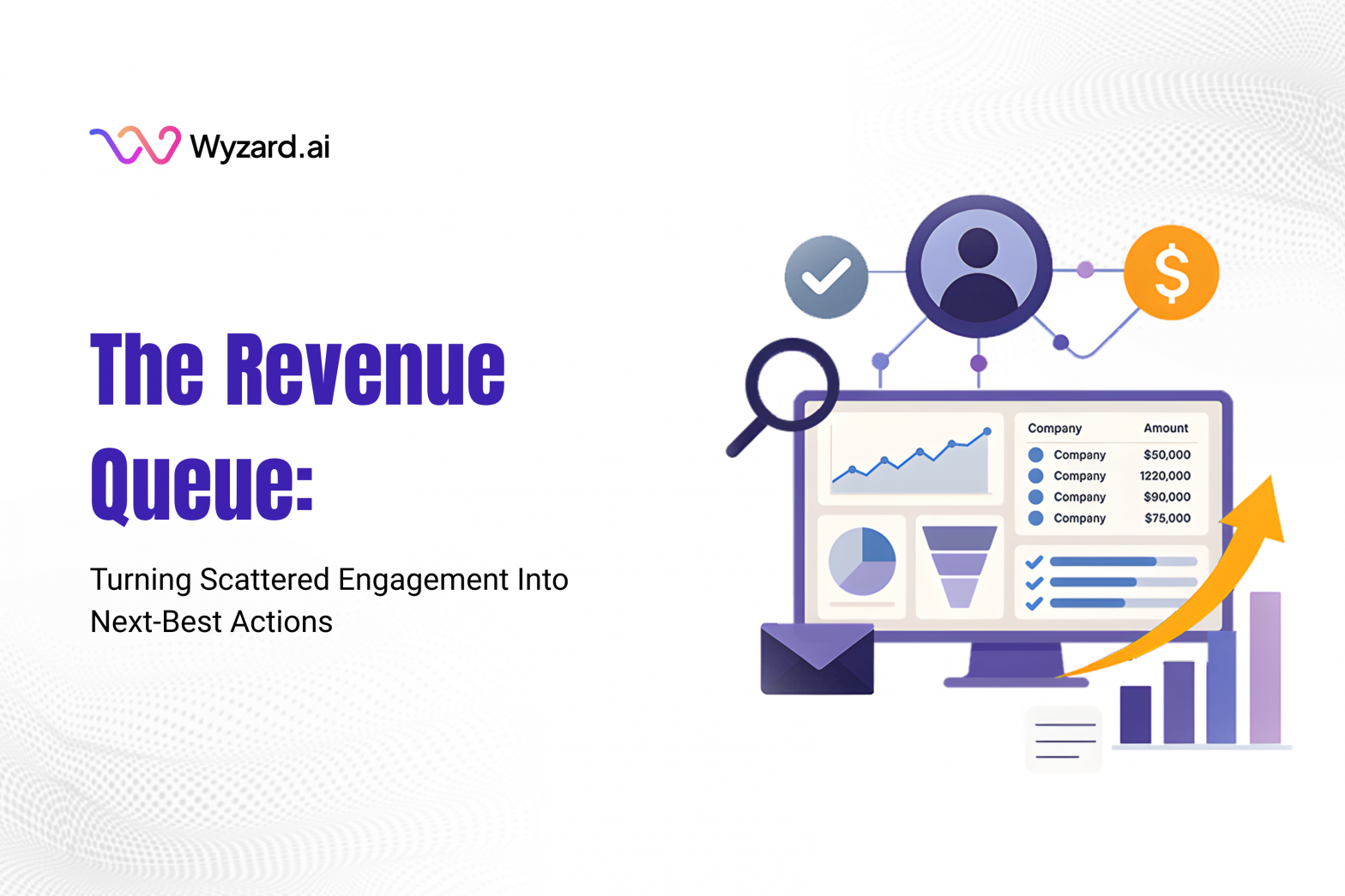
The Revenue Queue: Turning Scattered Engagement Into Next-Best Actions
Published
Categorized as Uncategorized
Subscribe Now
Every CMO knows this tension. Demand programs drive engagement. Events fill up. Webinars bring registrations. Paid campaigns earn clicks. CRM dashboards show activity across the board. Revenue growth can still feel harder than it should.
The issue is not a lack of engagement. The issue is what happens after engagement shows up.
A lead visits your website after clicking a LinkedIn ad. Another gets scanned at an industry event. A third attends a webinar and replies to a nurture email days later. Each signal looks promising on its own. Together, they can create uncertainty about what should happen next.
That is the gap Wyzard, the Signal-to-Revenue AI, is built to close. It captures buyer signals the moment they happen and runs the right follow-up across channels so intent turns into revenue rather than getting stuck across disconnected systems.
Why CMOs Get Stuck on “What Happens Next”
From a CMO’s perspective, the funnel rarely looks empty. Engagement metrics trend upward. Marketing is doing its job.
Sales feedback can still sound familiar. Leads arrive without context. Follow-ups feel mistimed. SDRs spend time sorting signals instead of having real conversations. High-intent buyers can wait too long for outreach when teams are busy reacting to lower-value activity.
That creates pressure for CMOs. Pipeline confidence weakens. Attribution becomes harder to defend. Forecast discussions can shift from growth strategy to cleanup work.
The root cause is simple. Most GTM stacks capture signals. Few stacks sequence actions.
Engagement Is Not the Same as Revenue Momentum
Modern GTM teams collect signals everywhere. Website visits, event badge scans, webinar attendance, LinkedIn ad clicks, email replies, product interest. The challenge is that not every signal deserves the same response.
A pricing page visit after weeks of engagement can signal real buying intent. A single paid click can mean curiosity. A webinar attendee who asks a question shows different intent than someone who never joins live. An event scan paired with post-event site activity carries more weight than a scan alone.
When context is missing, teams treat all signals as equal. That leads to slow response, wasted effort, and missed opportunities.
This is where the revenue queue becomes useful.
What a Revenue Queue Means
A revenue queue answers one question clearly.
What is the next-best action for this buyer, right now?
Instead of reacting to whichever signal arrives last, a revenue queue evaluates intent across channels, ranks signals by relevance, and sequences actions that move deals forward.
This shifts teams from constant reaction to deliberate execution. It matches how CMOs think about revenue. Outcomes first. Actions second.
That mindset sits at the center of a System of Outcomes.
From Systems of Action to a System of Outcomes
Many GTM stacks operate as systems of action. A signal fires, a task triggers, activity follows. Volume increases. Clarity does not.
A System of Outcomes works differently. It starts with the business result and works backward. Meetings booked. Pipeline created. Deals accelerated.
Actions happen when intent supports the outcome. This separates motion from progress.
Wyzard, the Signal-to-Revenue AI, is built around this principle. It does not just automate follow-ups. It decides which follow-up matters most for revenue.
The Role of the GTM Intelligence Graph
Sequencing actions requires context that no single tool provides.
A GTM Intelligence Graph connects signals across CRM, marketing automation, event platforms, paid media, and sales tools. It links identity, behavior, timing, and channel activity into one intent view.
For CMOs, this changes the buyer experience. Follow-up matches behavior instead of feeling generic. For Sales and RevOps, leads arrive with context rather than guesswork.
This connected view supports signal prioritization across the full GTM motion.
How Next-Best Actions Get Chosen
Next-best actions are not static sequences. They change based on buyer behavior and momentum.
Consider a few examples.
- An account clicks a LinkedIn ad and visits a blog post. That account fits a nurture path.
- The same account attends a webinar, asks a question, then revisits pricing. That pattern can fit sales outreach.
- An event scan followed by silence fits one follow-up path. An event scan followed by email replies and site activity fits another.
Choosing the right action depends on intent patterns, timing, and outcomes. This logic is central to the Signal-to-Revenue AI model.
Why Sales Engagement Tools Hit a Ceiling
Tools like Outreach or Salesloft can run sequences well once a sequence exists.
They do not decide which sequence should run, when it should start, or
whether outreach should happen at all.
Those decisions still depend on humans stitching together signals across tools. By the time that work happens, intent can fade.
The missing layer is orchestration. The need for a Signal-toRevenue AI arises.
How Wyzard.ai Runs the Revenue Queue
Wyzard, the Signal-to-Revenue AI, works as an AI GTM orchestration platform. It captures signals across every major channel and sequences actions aligned to real buying intent.
This includes buyers who are:
- Visiting your website
- Scanned at a live event
- Clicking on a LinkedIn ad
- Attending a webinar
- Replying to a nurture email
Wyzard.ai evaluates these signals together instead of treating each one in isolation. Then it selects the next step that supports revenue.
Two core products drive this flow.
WyzGoal
WyzGoal lets teams define outcomes in natural language. Examples:
- “Book meetings with accounts showing late-stage intent.”
- “Prioritize event leads with follow-up engagement.”
- “Move webinar attendees with pricing interest into SDR outreach.”
Goals guide execution. Static rules do not need to carry the full burden.
WyzChannels
WyzChannels executes those goals across email, LinkedIn, chat, voice, and sales workflows. Outreach stays coordinated and timely across channels, with a consistent narrative and clean handoffs.
Under the hood, AI GTM Engineers carry out these goals. They operate with human oversight so strategy and brand control stay intact.
What Changes for CMOs, RevOps, and Sales
When a revenue queue replaces reactive follow-up, the GTM experience shifts.
CMOs gain confidence that engagement turns into measurable outcomes. Sales teams spend more time with accounts that can convert. RevOps gets cleaner routing and less manual triage. Forecast discussions focus on growth instead of cleanup.
That is the promise of Wyzard, the Signal-to-Revenue AI: orchestrating every signal into revenue.
Turning Engagement Into Predictable Revenue
Most GTM teams already have a strong stack. The challenge is acting on intent before it fades across systems.
Wyzard, the Signal-to-Revenue AI, connects your stack, captures buyer signals live, and sequences the right action across channels with human oversight. The result is fewer leads lost, faster engagement, and more predictable revenue.
If you want to see the revenue queue in action, book a demo and see Wyzard, the Signal-to-Revenue AI at work.
Other blogs
The latest industry news, interviews, technologies, and resources.
March 30, 2026
The Signal-to-Revenue Blueprint for Agentic ABM
A CMO reviews the weekly dashboard and sees strong activity. A target account clicked a LinkedIn ad. Another stakeholder ...

March 27, 2026
What Is Agentic ABM? A Practical Guide for Enterprise GTM Teams
Enterprise GTM has an action gap. If you are a CMO, this scene is familiar. A target account clicks ...
