 We’ve secured funding to power Signal-to-Revenue AI to GTM teams globally. →
If you are a CMO, this situation feels familiar. Your team has a CRM, marketing automation, paid campaigns, webinars, ...
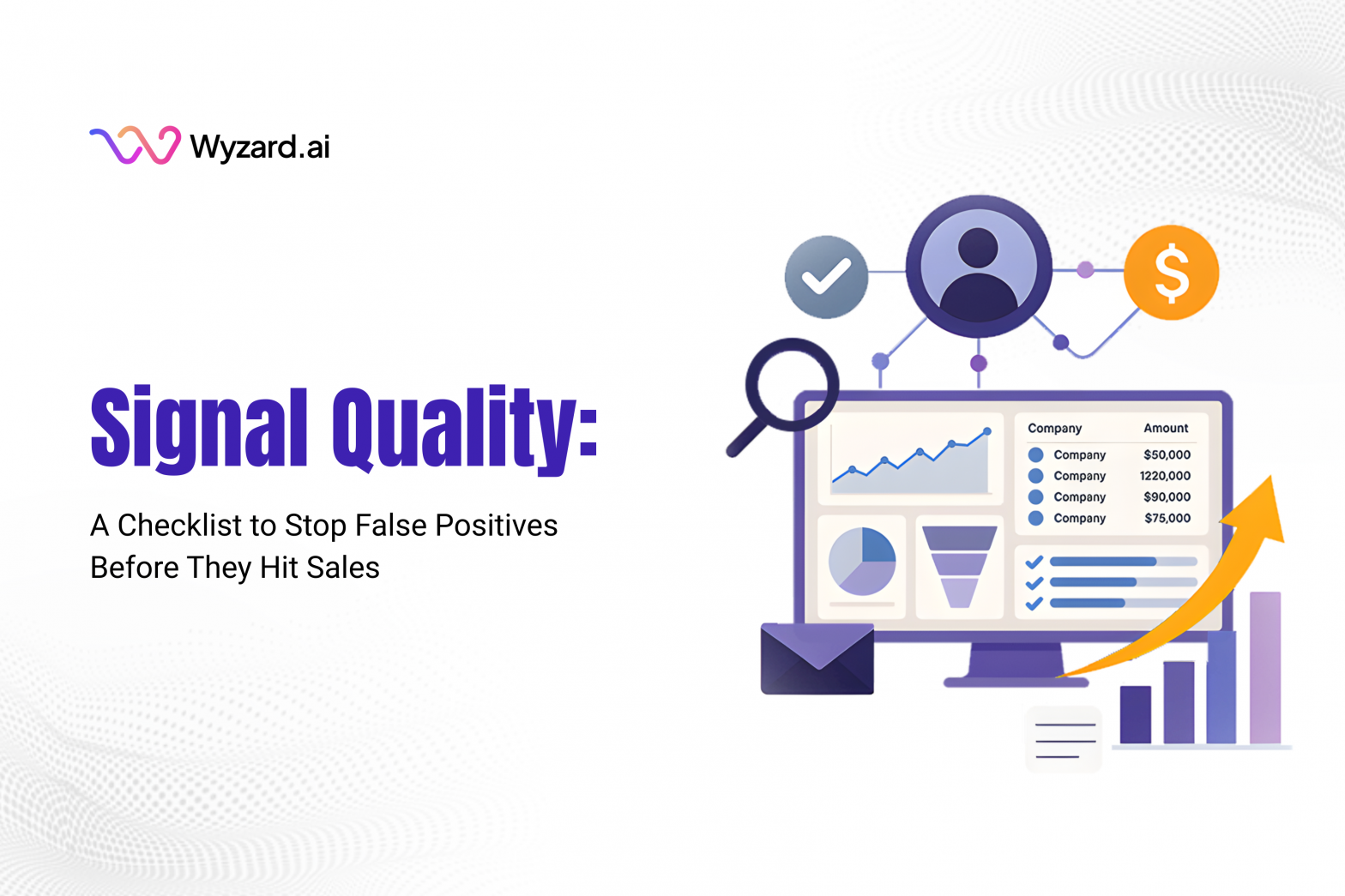
Signal Quality: A Checklist to Stop False Positives Before They Hit Sales
Published
Categorized as Uncategorized
Subscribe Now
CMOs keep hearing the same story in pipeline reviews. Demand gen is producing activity. Engagement metrics look healthy. Sales still reports that “the good leads are rare.”
That gap shows up in every channel, not just on your website. It shows up when an event badge scan turns into an SDR task. It shows up after a webinar registration that never becomes attendance. It shows up when a LinkedIn ad click looks like intent, then stalls. It shows up when a nurture email reply comes from someone outside the buying team.
Signals arrive fast. Revenue does not follow automatically.
Wyzard, the Signal-to-Revenue AI, exists for that moment. It captures buyer signals as they happen, connects your GTM stack, and triggers the right follow-up across channels so real intent becomes revenue and noise stops at the door.
Why Signal Quality Is Now A CMO Problem
Most teams do not lack data. They lack trust in what the data means.
When sales teams chase weak signals, two things happen. SDR time gets wasted. Sales leaders stop believing in marketing-sourced intent.
For CMOs, that creates a second-order issue. Forecasting gets messier. Attribution gets shakier. Budget conversations shift from “what will we scale?” to “what can we defend?”
Signal quality is the difference between a funnel that moves and a funnel that looks busy. A Signal-to-Revenue AI is needed here.
What “False Positives” Really Cost
False positives show up when activity is treated like buying intent.
Common examples:
- A badge scan from a conference attendee who wanted swag, not a demo
- A webinar registrant who never attends and never returns
- A paid click from someone researching a category for content, not procurement
- A pricing page visit from a student, a partner, or a competitor
Push these signals into sales and the cost is real:
- Reps chase accounts that were never ready
- High-intent prospects wait longer than they should
- Pipeline looks inflated, then collapses later
CMOs feel it in CAC, sales velocity, and board confidence.
A Better Model: Outcomes First, Actions Second
Many GTM stacks run as systems of action. Capture activity. Trigger tasks. Create more motion.
A System of Outcomes flips the logic. Start with the outcome. Validate intent. Then execute the next step that best supports revenue.
This shift requires cross-channel context. No single tool has the full story. That story lives across CRM, marketing automation, events platforms, paid media, sales engagement, and email.
Wyzard, the Signal-to-Revenue AI, brings that story together and turns it into coordinated follow-up.
The Signal Quality Checklist Cmos Should Demand From A Signal-To-Revenue Ai
Use this checklist for any signal, regardless of source, and expect a Signal-to-Revenue AI to enforce it automatically across your GTM stack. Website visits, event scans, webinar actions, LinkedIn ad engagement, nurture replies, inbound demo requests, a true Signal-to-Revenue AI applies the same standards everywhere, without forcing teams to manage it manually.
1) Is the signal connected to context?
One action rarely tells you enough.
A webinar attendee who joins live, asks a question, clicks the follow-up link, then revisits your product pages signals serious interest. A single registration does not.
This is where a GTM Intelligence Graph earns its place. It connects identity, behavior, and timing across systems, turning isolated events into intent patterns.
If the signal has no context, treat it as unverified.
2) Does the signal match buyer stage?
A lot of GTM friction comes from stage mismatch.
Early-stage behavior:
- Reading blog content
- Viewing category pages
- Light engagement with ads
Late-stage behavior:
- Comparing solutions
- Visiting pricing or security pages
- Requesting a demo
- Replying with specific buying questions
Stage mismatch sends the wrong message at the wrong time. Sales outreach hits too early. Nurture hits too late. The prospect experience suffers.
3) Is the signal enriched with fit and role clarity?
Raw activity is incomplete.
Enrichment adds the details that matter:
- Company size and industry fit
- Role and buying influence
- Tech stack context
- Prior engagement across channels
Without enrichment, reps spend time doing basic research. Response speed drops. Lead routing becomes inconsistent.
For CMOs, enrichment protects brand credibility. The outreach feels relevant, not generic.
4) Has intent been validated in real time?
Speed matters, yet speed alone can amplify noise.
Harvard Business Review has reported that fast follow-up is linked to higher conversion rates for inbound leads, with response time playing a major role in outcomes. Use that as a north star when setting SLAs, across forms, event follow-up, webinar workflows, and email reply handling.
Real-time intent validation asks:
- Is this account showing momentum across multiple touchpoints?
- Does the action align with late-stage behavior?
- What action fits the moment and the buyer stage?
Validation separates “interested” from “ready.”
5) Is there a defined outcome tied to the signal?
Every signal should map to a goal.
Examples of outcomes:
- Book a meeting
- Route to SDR with full context
- Launch a multi-touch sequence across email and LinkedIn
- Trigger a sales-assist play for an active opportunity
- Send a human follow-up task to the right owner
If the goal is “send it to sales and see,” you are feeding false positives into your funnel.
A System of Outcomes treats outcomes as the starting point, not an afterthought.
How Wyzard.Ai Turns Signal Quality Into Coordinated Execution
Wyzard, the Signal-to-Revenue AI, runs as an AI GTM orchestration platform. It captures signals across your channels, enriches them, validates intent, and orchestrates follow-up that matches the moment.
That includes leads who are:
- Visiting your website
- Scanned at an event
- Clicking a LinkedIn ad
- Attending a webinar
- Replying to a nurture email
Wyzard.ai’s execution is driven by AI GTM Engineers, goal-oriented agents that run plays tied to outcomes. They work with human oversight, so teams keep control of strategy, messaging, and escalation paths.
Key product concepts that fit this workflow:
- WyzSignals to unify and monitor buyer signals across tools
- GTM Intelligence Graph to connect behavior into intent patterns
- Orchestration across channels so follow-up aligns with where the buyer is engaging
For CMOs, this translates into cleaner pipeline, better sales trust, and fewer wasted cycles.
What Changes For A CMO Once False Positives Drop
When signal quality improves, the GTM experience shifts.
Marketing gets credit for real intent, not inflated activity.
Sales spends more time with accounts that can convert.
RevOps gets cleaner routing and better data hygiene.
Forecast calls become less defensive and more strategic.
That is the promise of the Signal-to-Revenue AI model: orchestrate every signal into revenue.
If you want to see how Wyzard.ai, the Signal-to-Revenue AI, captures signals across channels and turns verified intent into coordinated action, book a demo right now.
Other blogs
The latest industry news, interviews, technologies, and resources.
March 30, 2026
The Signal-to-Revenue Blueprint for Agentic ABM
A CMO reviews the weekly dashboard and sees strong activity. A target account clicked a LinkedIn ad. Another stakeholder ...

March 27, 2026
What Is Agentic ABM? A Practical Guide for Enterprise GTM Teams
Enterprise GTM has an action gap. If you are a CMO, this scene is familiar. A target account clicks ...
