 We’ve secured funding to power Signal-to-Revenue AI to GTM teams globally. →
If you are a CMO, this situation feels familiar. Your team has a CRM, marketing automation, paid campaigns, webinars, ...
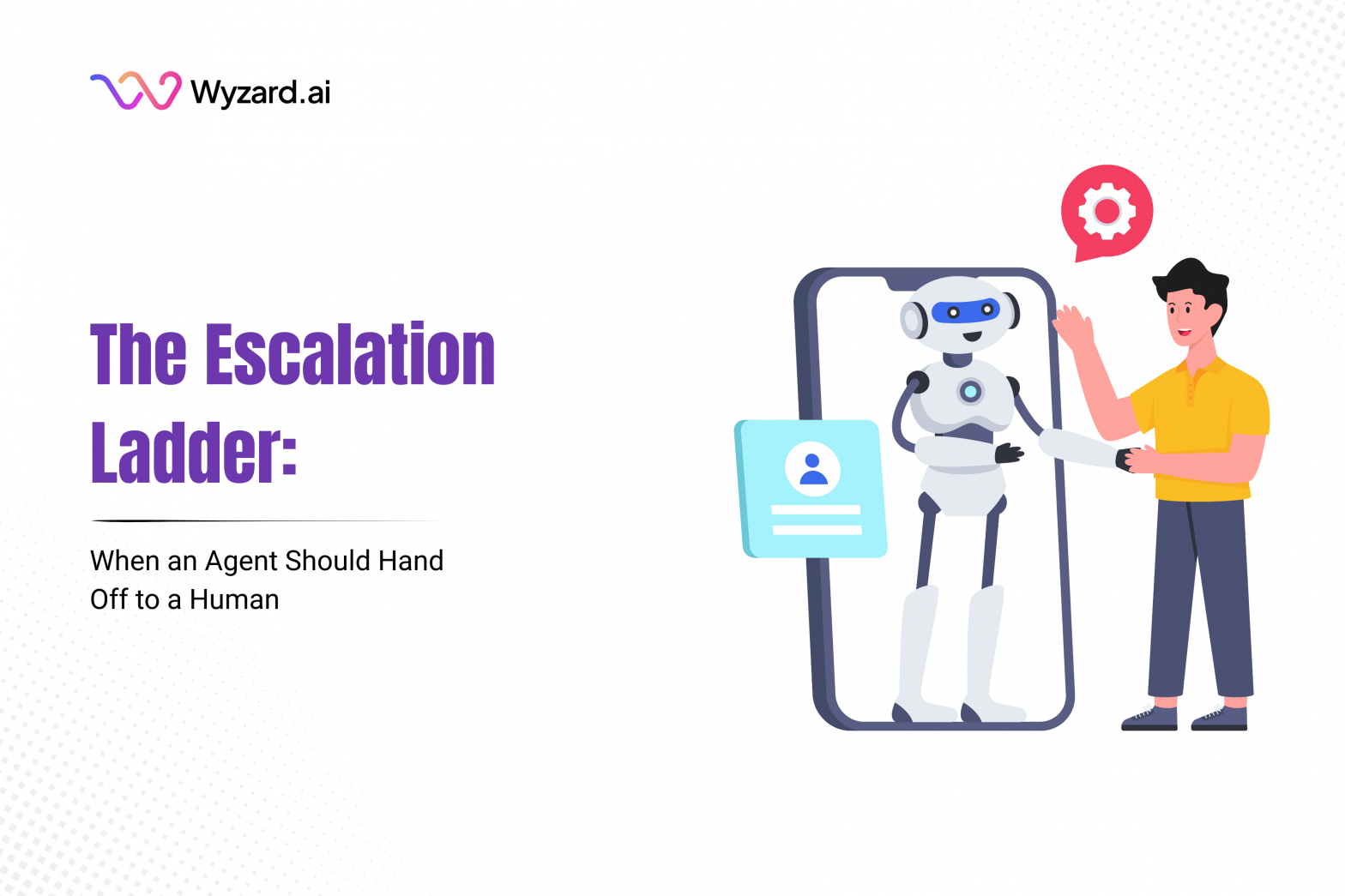
The Escalation Ladder: When an Agent Should Hand Off to a Human
Published
Categorized as Uncategorized
Subscribe Now
A CMO said it plainly in a revenue review: “Fast is good. Lost trust is expensive.” The team had rolled out an agent-led workflow to respond faster to inbound interest. It worked, right up until a pricing question from a strategic account got a response that belonged with sales. The buyer did not complain. The thread went quiet, and the deal momentum faded.
That moment captures the real challenge in agentic GTM. Automation that does not know when to pause can create more risk than slow execution ever will.
This is where Wyzard, the Signal-to-Revenue AI, takes a different approach. Wyzard.ai is built around Agentic AI and HITL and one practical question: when should an agent stop and pass the conversation to a person?
Speed Without Handoff Logic Breaks Trust
CMOs want faster engagement across channels. Buyers expect responses when they visit your website, scan a badge at an event, click a LinkedIn ad, attend a webinar, or reply to a nurture email. Delays cost pipeline.
At the same time, some moments call for judgment. Pricing, contracts, competitive questions, or signs of frustration are not “just another automated step.” Without clear guardrails, agentic systems escalate too often or not often enough, and both outcomes create friction.
This is exactly why Agentic AI with HITL matters. It blends automation with human judgment, with rules set before the moment arrives.
Why Chatbots Struggle with Handoffs
Many teams start with chatbots and hit limits quickly. Chatbots lean on static triggers, keyword matches, and scripts. They escalate when a word appears, not when the full context calls for it.
That leads to two recurring failures. Over-escalation floods sales and support with low-value interruptions. Under-escalation traps buyers in loops when the conversation turns serious.
The missing piece is context paired with graduated control. That is what an escalation ladder delivers.
What an Escalation Ladder is
An escalation ladder is a structured set of escalation rules that define when an agent continues and when a person steps in. It is not a one-time switch. It is a progression.
Each rung on the ladder defines:
- the condition that triggers escalation
- the role that receives the handoff
- the context passed along
With a clear ladder, automation runs confidently at the bottom and hands off cleanly at the top. This structure is a cornerstone of Agentic AI with HITL at scale.
Triggers that Call for a Human Handoff
In real GTM environments, certain signals consistently call for a Human Handoff:
- pricing, packaging, or discount questions
- contract, procurement, or legal language
- sentiment shifts that show confusion or frustration
- buying signals that point to late-stage intent
- strategic accounts or executive-level contacts
The mistake many teams make is handling these moments ad hoc. CMOs benefit when these triggers are defined upfront and applied consistently across channels.
Exceptions Protect the Moments that Matter Most
No rule set covers every scenario. That is where exceptions come in. Exceptions capture cases that are rare, yet high risk.
Examples include:
- outreach in regulated industries
- competitive comparisons
- executive-to-executive communication
- custom enterprise terms
Exception handling keeps uncommon situations from slipping through automation simply because they do not show up every day. In Agentic AI with HITL, exceptions deserve first-class treatment.
The GTM Intelligence Graph Turns Escalation into a Context-Driven Decision
Escalation decisions get far better with context. A pricing question from a student and one from a buying committee member should not land the same way.
The GTM Intelligence Graph connects account fit, buying group behavior, prior engagement, channel history, and CRM data into one view. With that context in place, escalation ladders can route conversations with precision. The same message can stay automated for one account and escalate for another.
This is how the combination of Agentic AI and HITL avoids blunt rules and keeps escalation aligned with real buyer intent.
Escalation Belongs Inside a System of Outcomes
Escalation is not a support metric. It is a revenue lever.
Inside a System of Outcomes, escalation ladders are measured by what happens next:
- deal progression after handoff
- conversion after human involvement
- buyer satisfaction signals
- sales time spent on higher-quality conversations
This outcome lens helps CMOs justify automation without trading away trust. Escalation ladders align speed with quality, not speed at the expense of quality.
How WyzAgents execute escalation ladders
Wyzard, the Signal-to-Revenue AI, applies escalation ladders through WyzAgents across the GTM channels where intent shows up:
- visiting your website
- lead scanned at an event
- clicking a LinkedIn ad
- attending a webinar
- replying to a nurture email
Each interaction is evaluated against the defined escalation ladder. Low-risk interactions continue automatically. Higher-risk moments route to the right person, with full context attached.
Sales does not receive a vague alert. Sales receives a clean handoff that includes what the buyer did, what they asked, what the agent responded with, and why escalation happened. That is Agentic AI with HITL that respects human attention.
AI GTM Engineers Keep Escalation Ladders Current
Escalation ladders do not design themselves. AI GTM Engineers define and refine them based on real GTM motion.
Their work includes:
- mapping signals to escalation triggers
- defining which roles handle which rungs
- tuning thresholds as markets shift
- aligning language with brand and compliance needs
This turns escalation into a living system that improves over time.
Clear Escalation Ladders Help Every GTM Role
Clear escalation logic supports multiple roles:
- CMOs protect brand trust and pipeline quality
- RevOps leaders gain consistency and audit trails
- sales teams receive better-timed handoffs
- SDRs avoid unnecessary interruptions
- legal and compliance teams gain visibility where review is needed
Teams move faster when handoffs are intentional and predictable.
Great Automation Knows When to Stop
Automation that never escalates creates risk. Automation that escalates constantly creates friction. The right balance sits in the middle, with clear rules and strong context.
Agentic AI and HITL provides that balance. With escalation ladders powered by a GTM Intelligence Graph and measured through a System of Outcomes, teams scale automation without losing trust.
Wyzard, the Signal-to-Revenue AI, orchestrates every signal into revenue while knowing exactly when to bring a person into the loop.
If you want to see how escalation ladders work across real buyer journeys, book a demo and see Wyzard.ai in action.
Other blogs
The latest industry news, interviews, technologies, and resources.
March 30, 2026
The Signal-to-Revenue Blueprint for Agentic ABM
A CMO reviews the weekly dashboard and sees strong activity. A target account clicked a LinkedIn ad. Another stakeholder ...

March 27, 2026
What Is Agentic ABM? A Practical Guide for Enterprise GTM Teams
Enterprise GTM has an action gap. If you are a CMO, this scene is familiar. A target account clicks ...
