 We’ve secured funding to power Signal-to-Revenue AI to GTM teams globally. →
If you are a CMO, one of the hardest moments in ABM comes when the dashboard is full of ...
A 90-Day Agentic ABM rollout Plan for Lean Enterprise GTM Teams
Published
Categorized as Uncategorized
Subscribe Now
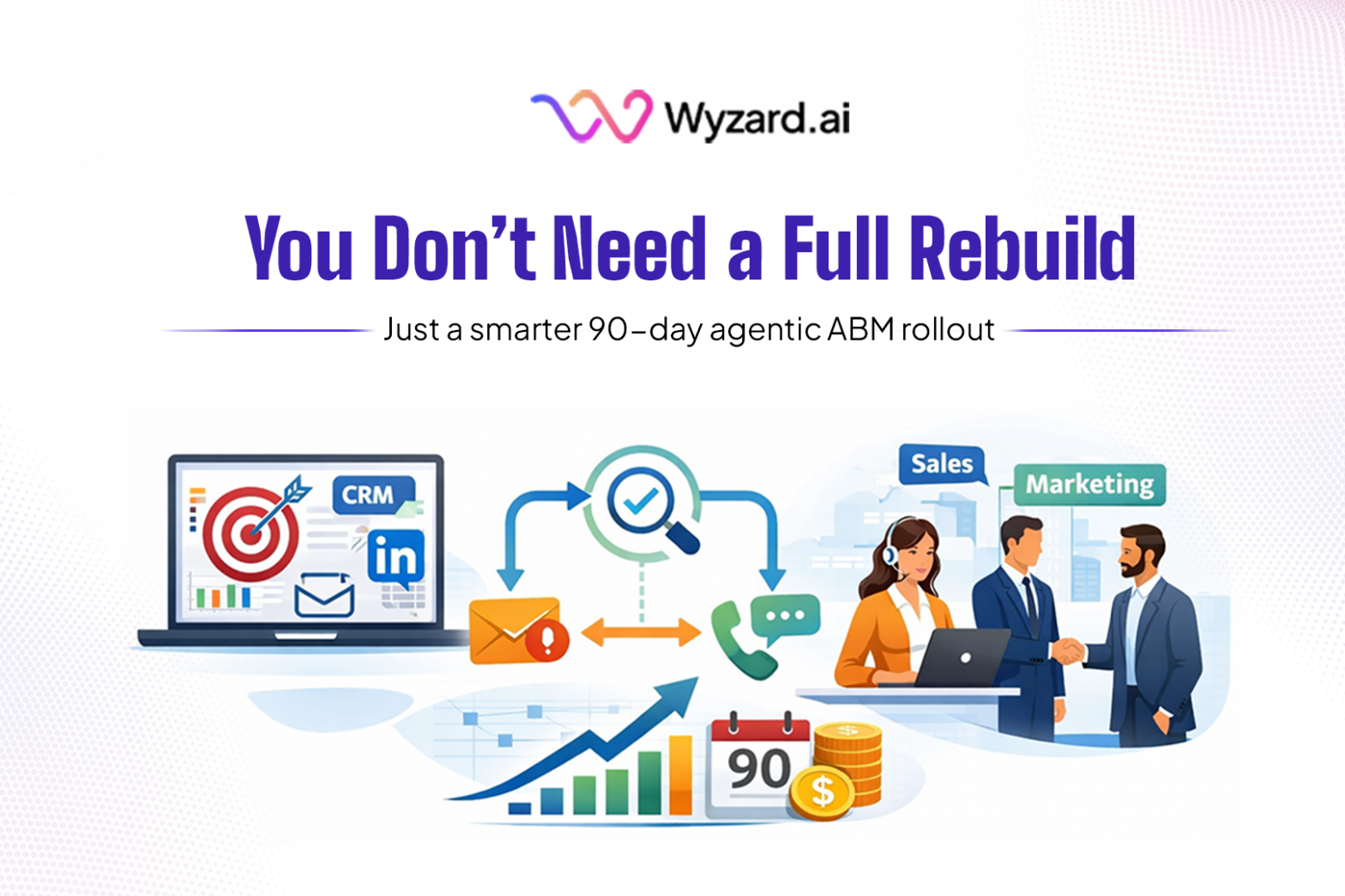
If you are a CMO leading a lean GTM team, the issue is rarely demand on its own. The issue is execution. Your team already has signals coming in from website visits, event scans, webinar signups, LinkedIn ad clicks, nurture email replies, and CRM activity. Those signals sit in different systems, ownership is unclear, and follow-up slows right when buyer intent is live. That is why a focused agentic ABM rollout matters. You do not need a full rebuild to get started. You need a practical 90-day path that connects signals, context, and action. Wyzard.ai is built for that gap. It positions itself as the Signal-to-Revenue AI for modern GTM teams, helping lean teams activate leads, personalize engagement across channels, and qualify buyers without large ops teams. For enterprise teams, this matters even more.
Why lean teams struggle to launch ABM well
Many teams do not fail on vision. They fail on rollout. The enterprise ABM strategy sounds right in the boardroom, yet execution breaks in the handoff between marketing, sales, growth, and RevOps. One team owns paid. Another owns webinars. Another handles events. Sales waits on routing. RevOps waits on clean signals. By the time everyone lines up, the moment is gone. Wyzard’s product pages speak directly to this problem. WyzSignals captures activity across ad clicks, high-intent visits, event scans, webinar signups, email engagement, paid, website, email, and events. WyzGoal and WyzChannels can launch timely follow-ups across chat, email, LinkedIn, and calling.
That is why a good agentic ABM rollout should start as an ABM pilot, not as a six-month transformation project. Lean teams need a tight scope, a clear signal set, and a way to prove value fast.
Days 1 to 14: Start small and build signal clarity
The first phase of an agentic ABM rollout should focus on 20 to 30 target accounts. The goal here is not scale. It is clarity. Pick accounts that match your ICP, confirm the buying environment you want to win in, and connect the core signals that already matter to your team. That includes website visits, paid clicks, webinar attendance, event scans, nurture email replies, and CRM activity.
This is the right moment to define your first signal-triggered outreach motion. If a target account attends a webinar and revisits a product page, what happens next? If an event lead matches ICP and clicks a follow-up email, who acts? Wyzard.ai supports this early-stage setup through WyzSignals for live signal capture, WyzEnrich for account context, and WyzQualify for fit and readiness logic. Its role pages show that marketing teams can use those signals to move faster, sales teams can act on real-time interest, and RevOps can apply one shared model for fit and readiness instead of separate rule sets.
Days 15 to 45: Expand the motion without losing focus
Once the first signals are flowing, the next stage of the agentic ABM rollout is expansion with discipline. This is where you refine ICP, widen coverage from 20 to 30 accounts to 70 to 100 accounts, and turn early learnings into a repeatable motion. You are still running an ABM pilot, yet now it starts to look like a real operating system.
This is the point where messaging should become role-aware and account-aware. A webinar attendee from operations should not get the same follow-up as a budget owner who clicked a pricing email. A repeat visitor from a target account should not sit in the same queue as a casual content downloader. WyzGoal converts plain-language goals into channel-specific sequences, and WyzChannels executes those plays with personalization at the lead level. That gives lean teams a practical way to test messaging by role, account type, and buying stage without building everything manually.
Days 46 to 75: Turn the rollout into live revenue motion
This is where the agentic ABM rollout becomes operational. By now, your team should move into coordinated multichannel engagement across email, LinkedIn, chat, calling, event follow-up, webinar follow-up, and paid-response workflows. The key is not just to send more touches. The key is to connect actions to real signals and keep context attached as the account moves.
Wyzard’s current platform architecture supports that flow. Its GTM Intelligence Graph acts as the shared context layer, WyzSignals captures cross-channel activity, WyzQualify scores readiness, WyzGoal defines the motion, and WyzChannels handles execution across chat, email, LinkedIn, and calling. That lets lean teams respond to a booth scan, a LinkedIn ad click, a nurture reply, and a webinar signup as one account story instead of four separate tasks.
During this phase, measure replies, warm leads, meetings, and SALs. A strong agentic ABM rollout should start proving where signals actually convert.
Day 75 and beyond: Add depth, not chaos
After the first 75 days, the rollout should get broader only if the system is already working. Add third-party intent, layer in partner activation, and refresh the account book quarterly. This is where the ABM operating model starts to matter more than individual plays. You are no longer asking whether one workflow worked. You are asking whether the team now has a durable way to turn live intent into revenue action.
Wyzard.ai describes this clearly through a System of Outcomes. Signals feed decisions, decisions trigger actions, actions create learning, and learning improves the next cycle. It ties that loop to the GTM Intelligence Graph and human oversight from AI GTM Engineers, who help define goals, tune logic, refine qualification, and keep execution aligned with revenue outcomes.
Why this rollout works for lean teams
The value of a staged agentic ABM rollout is simple. It gives CMOs a way to improve pipeline performance without waiting for new headcount, a new stack, or a perfect data environment. Wyzard.ai supports marketing, sales, growth, and RevOps, and its public role pages show that each team can work from the same signal layer instead of passing fragments between tools. That is what makes the rollout manageable. It is not about adding more software. It is about creating one motion that can see signals, qualify fit, route correctly, and act across channels with shared context.
A successful agentic ABM rollout does not start with a full rebuild. It starts with focused accounts, clear signals, measurable actions, and a system that can grow with demand. Wyzard.ai, the Signal-to-Revenue AI, gives lean enterprise teams that path through WyzSignals, WyzEnrich, WyzQualify, WyzGoal, WyzChannels, the GTM Intelligence Graph, a System of Outcomes, and AI GTM Engineers.
If your team wants a 90-day rollout with full platform access from day one, outcome focus, and a dedicated GTM architect, book a demo and see it in action.
Other blogs
The latest industry news, interviews, technologies, and resources.
March 16, 2026
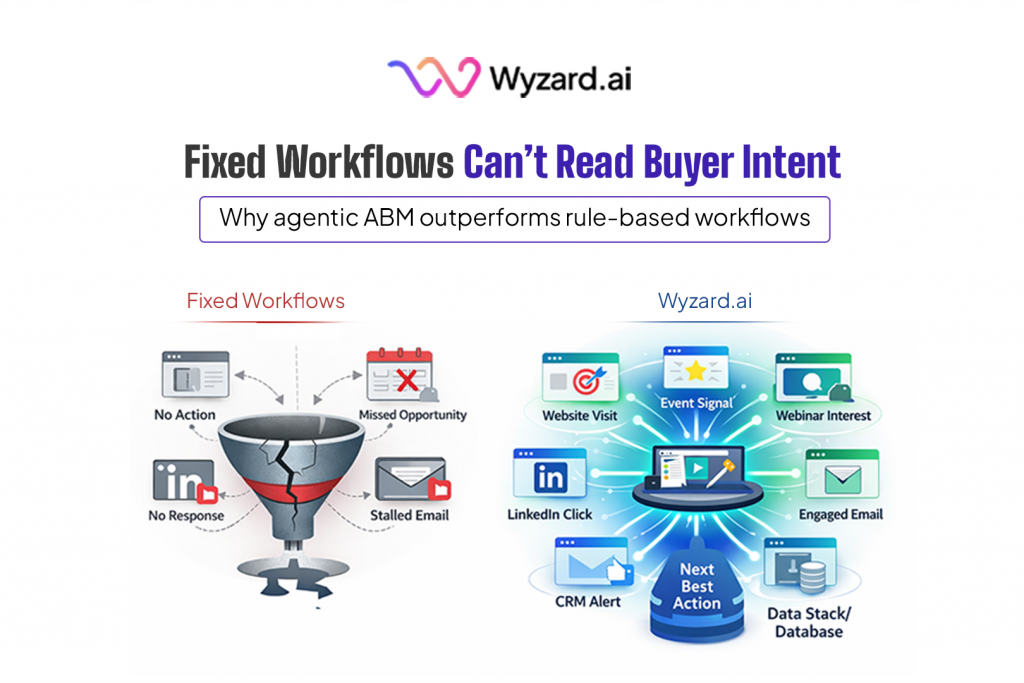
Automation Isn’t Intelligence: Why Agentic ABM Outperforms Rule-Based Workflows
A CMO reviews the weekly pipeline report and sees all the expected activity. A target account visited the website. ...

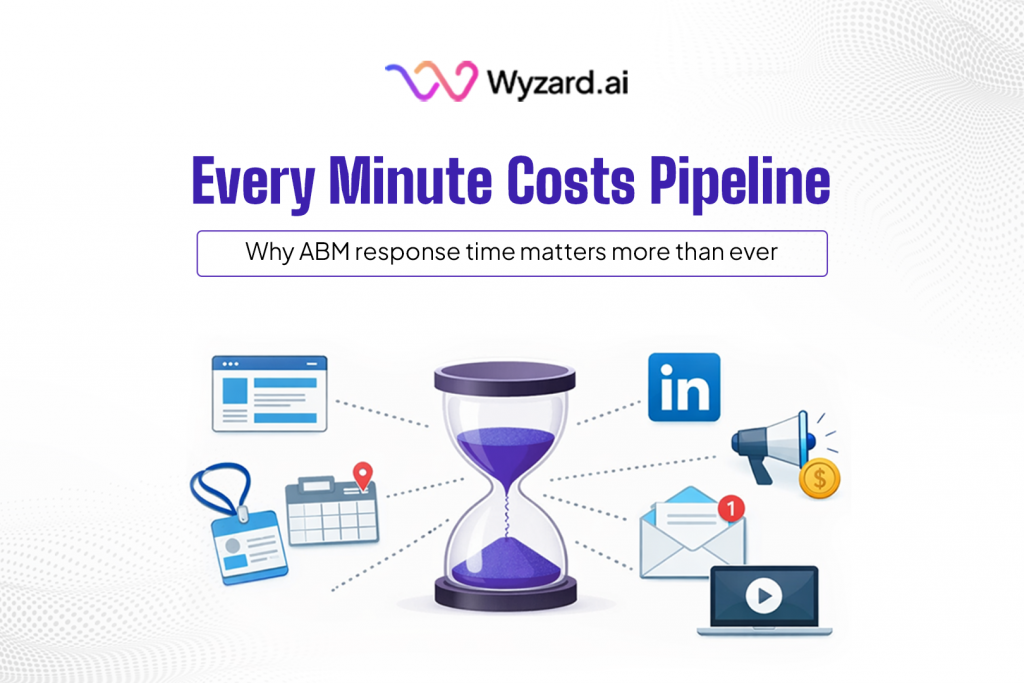
The 5-Minute Rule for ABM: How Fast Response Turns Buyer Intent Into Pipeline
If you are a CMO running enterprise growth, you have probably seen this in a pipeline review. A target ...
