 We’ve secured funding to power Signal-to-Revenue AI to GTM teams globally. →
If you are a CMO, one of the hardest moments in ABM comes when the dashboard is full of ...
Subscribe Now
Predictable revenue has become harder to achieve, even as teams collect more data, add more tools, and increase activity. Pipelines expand, but conversions stall. Meetings happen, but progress slows. Teams feel busy, yet outcomes feel uneven.
The problem isn’t effort. It’s architecture.
Most GTM systems today were built for a world of manual steps, linear funnels, and human-driven orchestration. That world is fading fast. Buyers behave differently, signals appear everywhere, and teams cannot manually interpret or coordinate these moments at the speed required.
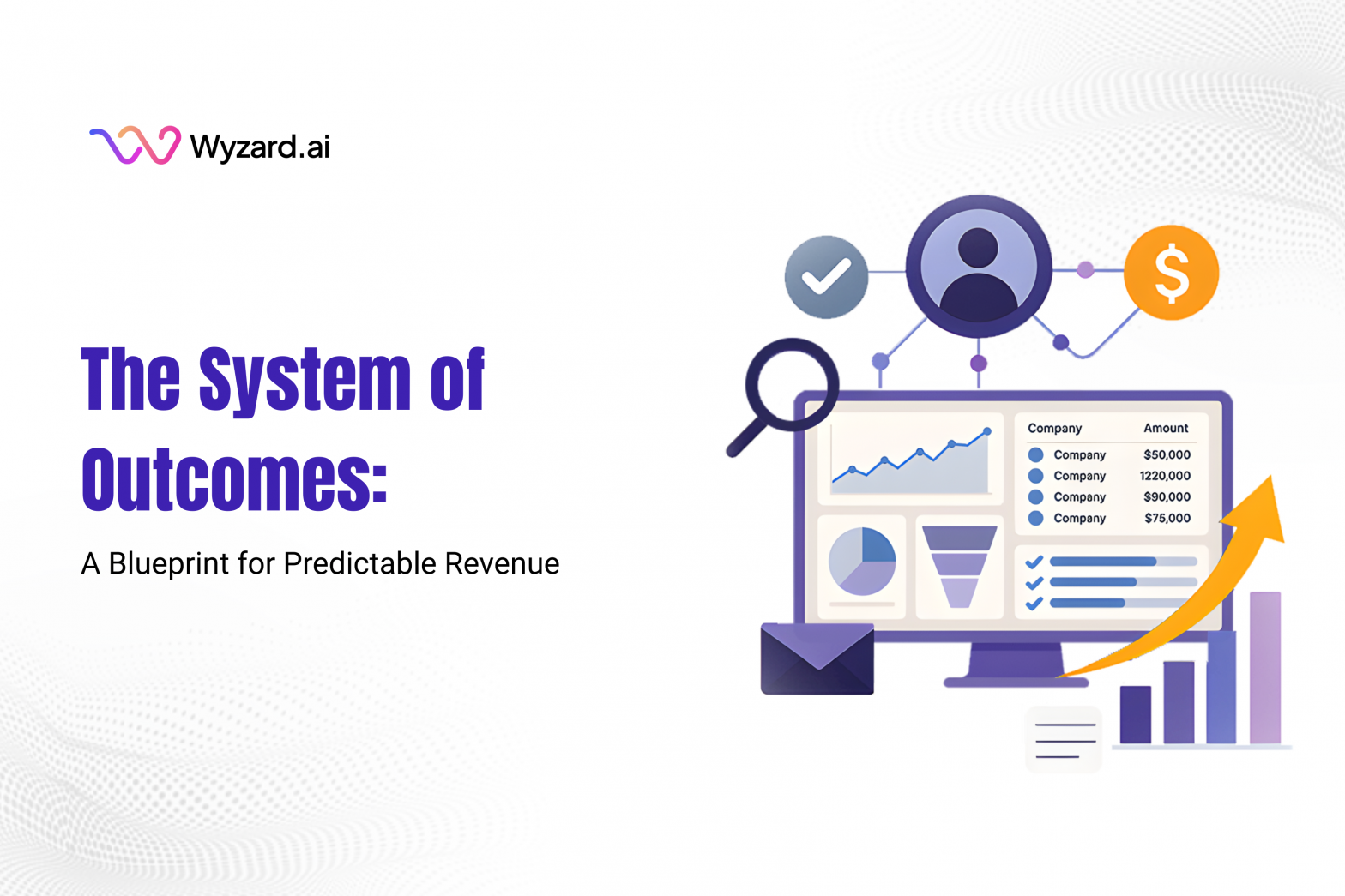
A new model is emerging. One that organizes revenue around outcomes rather than activity. One built for AI-era GTM execution. Wyzard.ai calls it the System of Outcomes.
This blueprint redefines how modern revenue engines work, and at its center is Wyzard, the Signal-to-Revenue AI.
Why Activity-Led GTM Creates Unpredictability
The traditional Salesforce + Outreach stack is activity-led. It relies on teams manually interpreting signals, pushing tasks, running sequences, updating fields, and coordinating follow ups. These motions were designed for a time when buyer behavior moved slowly and communication channels were limited.
But buyers now behave differently.
B2B decision makers now use many digital channels, moving back and forth across touchpoints unpredictably. They switch channels during the buying cycle, often multiple times.
This creates gaps in motion, context, and timing. Activity increases. Progress does not. Predictability disappears.
The answer isn’t more tools or more sequences. The answer is a new operating model. The answer is with Wyzard.ai.
Introducing the System of Outcomes
The System of Outcomes is a revenue blueprint built for AI-driven GTM teams. It shifts the center of gravity away from tasks and toward outcomes. Instead of optimizing for message volume, call volume, or workflow volume, it optimizes for the actions that progress deals.
A GTM engine built on a System of Outcomes focuses on three principles:
1. See every signal with clarity
Signals show intent long before a lead reaches a stage. WyzSignals listens across surfaces and channels to make these moments visible.
2. Interpret signals through one model
The GTM Intelligence Graph connects identity, timing, behavior, and context. It replaces fragmented data with a unified understanding of buyer readiness.
3. Coordinate execution toward the outcome
This is orchestration, not automation. System of Outcomes model uses orchestration to direct the next best action through WyzGoal and execute it through WyzChannels (Agentic Chat, Agentic Email, Agentic LinkedIn, and Agentic Calling).
These principles turn unpredictable revenue patterns into reliable ones.
How the System of Outcomes Differs From Traditional Stacks
Most legacy stacks assume a human will interpret data and coordinate action. The System of Outcomes assumes the opposite – the system interprets signals instantly and humans guide strategy.
This creates a structural advantage:
| Legacy Stack (Activity-Led) | System of Outcomes (Outcome-Led) |
| Built around tasks | Built around progress |
| Requires humans to interpret | Uses the GTM Intelligence Graph to interpret |
| Depends on workflows | Uses AI-driven Orchestration |
| Actions triggered by stages | Actions triggered by Real-Time Intent |
| Slow follow up | Fast execution through WyzChannels |
| Outcome measured at the end | Outcome drives every action |
This difference is why the System of Outcomes model creates predictability even in volatile markets.
Signal-to-Revenue AI: The Engine Behind the System of Outcomes
The System of Outcomes is the blueprint. The Signal-to-Revenue AI is the engine that brings it to life.
It connects the Wyzard ecosystem:
- WyzSignals captures signals across the entire stack
- WyzEnrich adds firmographic and identity context
- WyzQualify interprets readiness on the spot
- WyzGoal sets the outcomes the system should achieve
- WyzChannels executes through adaptive channels
- WyzGPT supports reasoning, adaptation, and long-term learning
This creates a revenue engine capable of:
- Reacting at the exact moment intent appears
- Coordinating actions automatically
- Keeping humans focused on high-value decisions
- Producing consistent results across months and quarters
The System of Outcomes model is not an ideal state. It is an achievable state with the right engine.
Why Predictability Returns Under a System of Outcomes
Predictable revenue doesn’t come from more activity. It comes from consistent progress. The System of Outcomes model ensures responses are always aligned with the moment interest appears, not when a workflow happens to trigger.
This reduces lag. It reduces manual interpretation. It reduces noise. And it increases the reliability of every pipeline stage. Predictability returns when systems guide outcomes instead of tasks.
The Next GTM Model Won’t Be Activity-Led
The next era of GTM execution will not favor teams with more sequences, more dashboards, or more data. It will favor teams that adopt a blueprint built around outcomes, powered by systems that interpret and act at the pace of buyer intent.
The System of Outcomes is that blueprint. The Signal-to-Revenue AI is the engine behind it. And Wyzard.ai is building the world’s first implementation of this model.
This is how modern revenue teams will operate. Not just faster. Not just with more visibility. But with more reliability.
See How the System of Outcomes Applies to Your GTM Engine
If you want your revenue engine to operate with clarity, purpose, and predictable progress, now is the moment to explore the System of Outcomes.
Teams that prioritize outcomes over vanity metrics can use this blueprint for predictable revenue to align every GTM motion with clear business results: outcomes over vanity metrics.
Predictable revenue emerges when teams build a system of outcomes that turns anonymous pricing page visits into qualified meetings without mandatory forms.
Book a demo and see how Wyzard, the Signal-to-Revenue AI, gives your team a blueprint for consistent revenue outcomes.
Other blogs
The latest industry news, interviews, technologies, and resources.
March 16, 2026
Automation Isn’t Intelligence: Why Agentic ABM Outperforms Rule-Based Workflows
A CMO reviews the weekly pipeline report and sees all the expected activity. A target account visited the website. ...

The 5-Minute Rule for ABM: How Fast Response Turns Buyer Intent Into Pipeline
If you are a CMO running enterprise growth, you have probably seen this in a pipeline review. A target ...
