 We’ve secured funding to power Signal-to-Revenue AI to GTM teams globally. →
If you are a CMO, one of the hardest moments in ABM comes when the dashboard is full of ...
Subscribe Now
At some point in growth, every revenue leader asks the same question.
“If we have more tools, more data, and more people, why does it feel harder to grow, not easier?”
Early on, a lean GTM setup feels sharp. One CRM, one automation tool, a few enrichment sources, maybe a chat widget. Then headcount rises. Channels expand. New tools join to cover new use cases. Integrations appear. Workflows stack on top of workflows.
Nothing explodes overnight. Instead, progress slows in small, frustrating ways. Response times slip. Forecasts feel less reliable. Channel performance swings for reasons no one can explain. Teams feel busy yet pipeline feels fragile.
That is the moment the stack starts to break at scale. The fix requires a different operating model, led by Wyzard, the Signal-to-Revenue AI.
What “Broken at Scale” Looks Like
A stack rarely fails in dramatic fashion. The symptoms show up quietly across the go to market engine.
- Marketing sees plenty of form fills but inconsistent revenue impact
- Sales spends more time jumping between tabs than speaking with buyers
- Ops manages integration errors instead of improving performance
- Leadership reviews dashboards that contradict one another
Underneath all of this sits a simple reality. The stack grew faster than the model that organizes it.
Research from Gartner notes that only 15 percent of organizations see strong performance from their marketing technology investments, while less than half of tools are actively used.
Tool growth outpaced system design. That is the heart of the problem.
Stack Complexity Is Not Just An IT Problem
At a small scale, each tool feels helpful. A new channel, a better analytics view, a plugin that patches a gap. Over time those additions create hidden drag. This is stack complexity in practice.
- Every tool has its own data model
- Every team builds custom workflows
- Every channel owns a slice of buyer behavior
The result is not one GTM system. It is many partial systems that need constant reconciliation.
This drag does not sit inside IT alone. It shows up in daily execution.
- Reps update the CRM after calls and lose momentum
- Marketers export lists and upload them into other tools
- RevOps builds reporting to stitch together disconnected activity
The more the company grows, the heavier these processes feel. Growth exposes the limits of the original architecture.
Signal Fragmentation: The Real Reason You Miss Buyer Moments
Growth increases channel surface area. Web, email, chat, product, partner, events, paid programs. Buyers move across all of them in unpredictable ways.
Each interaction creates a signal. A pricing visit. A product spike. A reply to a tailored outbound note. A chat conversation about contract terms.
If those signals land in separate systems with separate owners, they never form a coherent picture. This is signal fragmentation.
Fragmented signals drive three problems:
- High intent moments pass without timely follow up
- Lower intent leads receive the same attention as high intent ones
- Forecasts reflect past activity, not current reality
At scale, that adds up to real revenue leakage.
Why This Breaks Scalability
Growing companies expect that more tools and more activity will support growth. In practice the opposite often happens.
A stack with rising complexity and fragmented signals cannot sustain true scalability. Every new channel, integration, or data source adds friction. Teams must work harder just to keep current output, with little capacity left to improve outcomes.
Traditional fixes address the surface:
- New workflows
- New dashboards
- New rules in sales engagement tools
These may help for a short period. They do not solve the structural issue. The engine still lacks one place that can see every signal, interpret intent, and steer action.
This is the gap that Wyzard, the Signal-to-Revenue AI fills.
A Different Operating Model: The Signal to Revenue Operating System
To stop stacks from breaking at scale, GTM teams need an operating model that treats signals and outcomes as first class objects. Wyzard, Signal to Revenue Operating System.
It is not a separate product. It is a pattern for how the GTM engine runs across the full Wyzard stack.
The flow looks like this:
- Capture
WyzSignals listens across web, product, CRM, chat and marketing systems. Nothing useful sits in a blind spot. - Understand
The GTM Intelligence Graph connects actions to accounts and people. WyzEnrich adds context. WyzQualify reads intent and readiness in real time. - Decide
WyzGoal tells the system what outcome matters for that motion. Book meetings, move trials to paid, revive dormant accounts, protect renewals, and more. - Act
WyzChannels engages through Agentic Chat, Agentic Email, Agentic LinkedIn, or Agentic Calling, with WyzGPT shaping tone and content for each interaction.
The entire loop runs under the control of Wyzard, the Signal-to-Revenue AI. That engine sees the full stack, not one tool at a time.
The System of Outcomes: From Activity To Progress
The operating model handles motion. The strategy behind it is the System of Outcomes.
In an activity-led stack, teams track sends, calls, and tasks. Progress is implied, not guaranteed. In a System of Outcomes, teams track movement that links directly to revenue.
Examples:
- Qualified meetings held instead of calls scheduled
- Trials that reach clear activation milestones instead of signups alone
- Accounts that progress stages in a consistent pattern instead of sporadic touches
The Signal-to-Revenue AI supports this shift by making sure every outbound action, every follow up, and every nudge exists for a clear reason. WyzGoal encodes that reason. The rest of the Wyzard products execute it.
This is what moves a stack from “busy” to “effective”.
What Changes For GTM Leaders At Scale
Once the GTM engine runs on Wyzard, the Signal-to-Revenue AI, leaders begin to notice several practical changes.
- Reviews focus on where the system moves accounts and where it stalls, not just on activity counts
- Marketing and Sales share the same view of which accounts are warming up and why
- Ops spends less time repairing integrations and more time designing better flows
- Reps enter fewer fields and spend more time in live conversations
In short, the stack stops fighting growth. It starts supporting it.
The company still uses multiple tools. The difference comes from a unifying brain and a clear model for progress, rather than a chain of loosely connected platforms.
That is what a stack built for scale feels like.
See Where Your Stack Is Breaking
If your GTM stack feels heavier every quarter, the issue is rarely one person or one tool. It is the way signals, systems, and outcomes connect.
The Signal-to-Revenue AI gives you a way to rewire that connection without throwing everything out and starting again.
Wyzard.ai uses the full product set to do this:
- WyzSignals to catch every meaningful action
- WyzEnrich to add the missing context
- WyzQualify to read intent quickly
- WyzGoal to keep the system pointed at real outcomes
- WyzChannels and WyzGPT to act at the moment that matters
If you want to see how this looks over your own stack, the next step is simple.
Book a demo and watch how Wyzard, the Signal-to-Revenue AI, turns a fragile stack into a GTM system built to grow
Other blogs
The latest industry news, interviews, technologies, and resources.
March 16, 2026
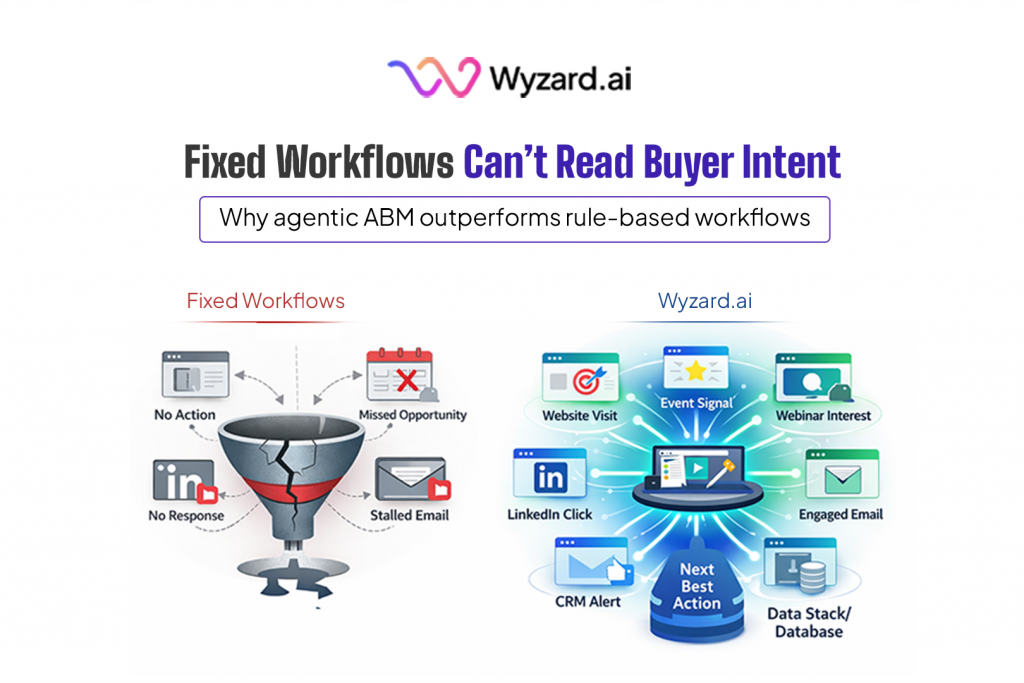
Automation Isn’t Intelligence: Why Agentic ABM Outperforms Rule-Based Workflows
A CMO reviews the weekly pipeline report and sees all the expected activity. A target account visited the website. ...

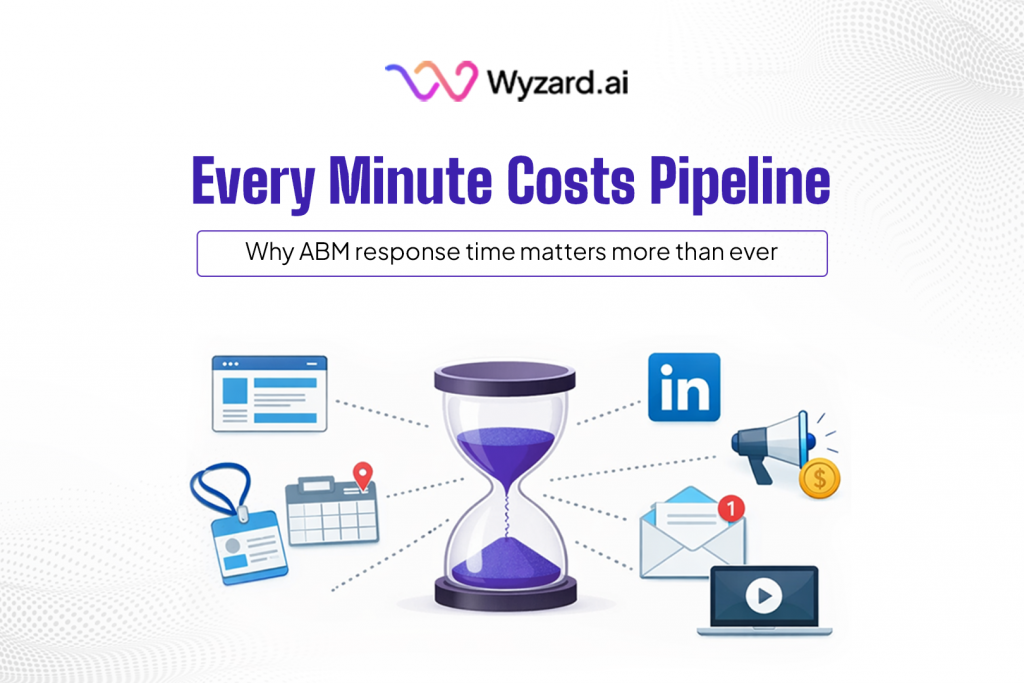
The 5-Minute Rule for ABM: How Fast Response Turns Buyer Intent Into Pipeline
If you are a CMO running enterprise growth, you have probably seen this in a pipeline review. A target ...
