What Is Agentic ABM? A Practical Guide for Enterprise GTM Teams
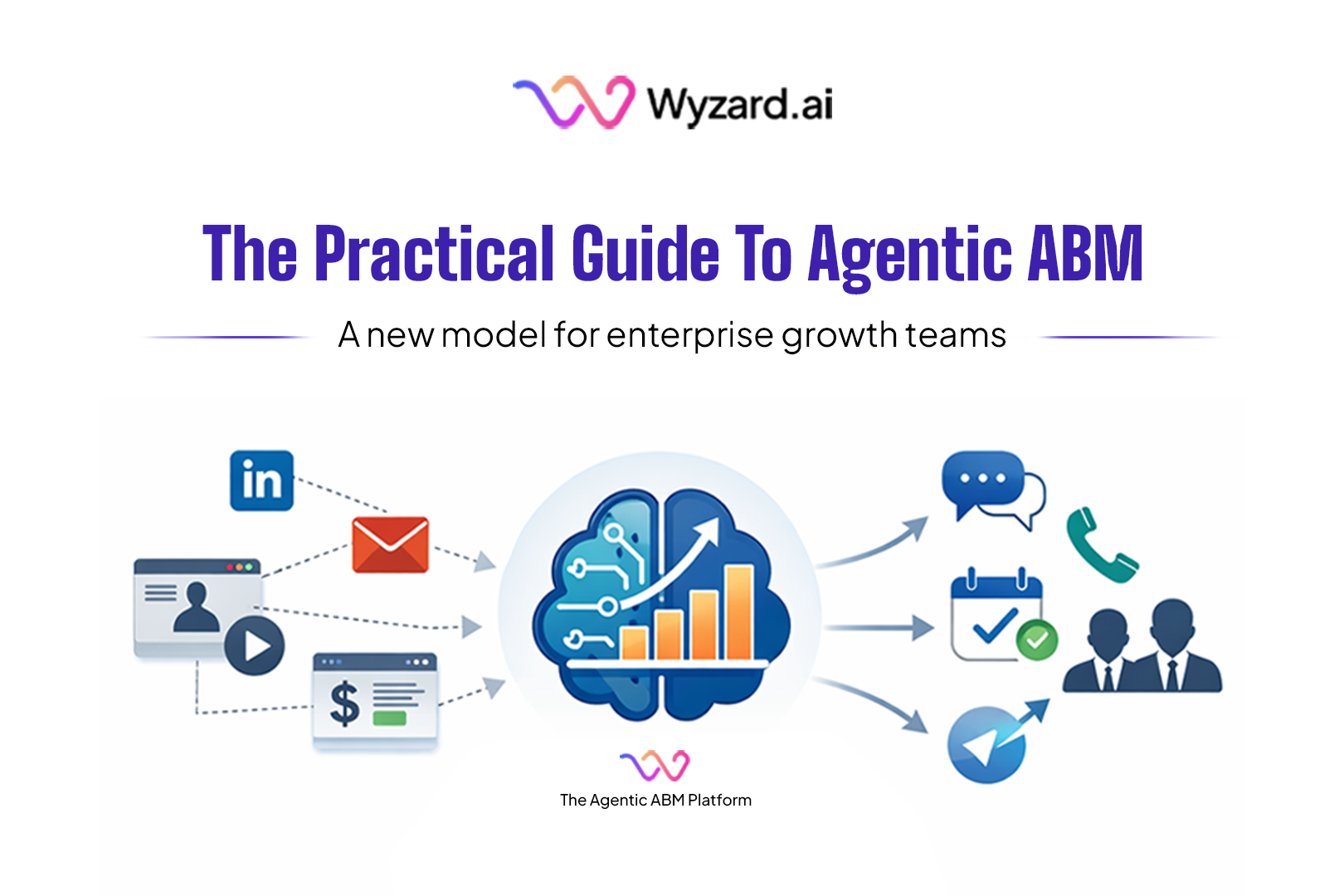
Enterprise GTM has an action gap. If you are a CMO, this scene is familiar. A target account clicks a LinkedIn ad on Monday. A second person from the same company joins your webinar on Tuesday. A known contact visits the pricing page on Wednesday. Someone replies to a nurture email on Thursday. The activity is real. The account looks active. Yet the follow-up lands late, in the wrong channel, or with no shared context across teams. That gap is the reason agentic ABM matters.
Wyzard.ai frames this problem clearly in its current positioning as the Signal-to-Revenue AI. Buyer signals show up across the stack, then revenue gets lost when nobody connects the dots fast enough.
What is Agentic ABM?
Agentic ABM is an account-based go-to-market model that does more than capture activity or trigger static workflows. It listens for signals, adds context, decides what matters, and starts the next best action across the right channel. That could mean email, LinkedIn, chat, calling, event follow-up, webinar follow-up, or an internal alert for sales. In simple terms, this turns signals into decisions and decisions into action.
That is why it fits enterprise teams so well. It is built for AI GTM orchestration, not just basic task execution. It gives teams a way to act on buyer intent with shared account intelligence and clearer revenue orchestration.
How Agentic ABM differs from legacy ABM
Legacy ABM usually depends on fixed account lists, campaign calendars, manual research, and delayed handoffs between marketing and sales. Traditional GTM automation is useful for routing forms, launching nurture emails, and handling repetitive work. The limitation shows up when buying activity spreads across channels and across people. Forrester reported in its 2024 business buying research that an average B2B purchase involves 13 people, and 89% of purchases involve two or more departments. That is a hard environment for campaign-led ABM and one-size-fits-all automation.
Agentic ABM works from a different logic. It is signal-led, context-aware, and account-level by design. It treats a LinkedIn click, a webinar attendance, a website revisit, an event scan, and an email reply as parts of one account story when those events point to the same buying motion. That shift matters for CMOs trying to get more pipeline from traffic and programs they already paid for.
Marketing automation, SDR follow-up, and Agentic ABM
Marketing automation
Marketing automation is strong at sequencing, routing, and campaign delivery. It gives teams structure and scale. It does not usually reason across live account context on its own. If three signals show up in three systems, the platform may process each one separately unless someone has already built the logic to connect them.
SDR-led follow-up
SDRs bring judgment, tone, and relationship-building. That human layer still matters. The challenge is bandwidth. No SDR team can manually monitor every event lead, webinar attendee, ad click, site visit, nurture reply, and CRM update across every target account in real time.
Agentic ABM
Agentic ABM sits between those two models and improves both. It captures activity live, adds context, checks fit and readiness, then launches the right next step with human oversight where needed. That is the operating model Wyzard.ai describes across WyzSignals, WyzEnrich, WyzQualify, WyzGoal, and WyzChannels.
What makes Agentic ABM work in practice
Signals
Signals can come from many places: website visits, event booth scans, webinar registrations, LinkedIn ad clicks, nurture replies, paid engagement, CRM activity, and sales interactions. WyzSignals is built to capture that activity across the digital footprint and bring it into one flow.
Context
Signals are not enough on their own. Teams need fit, history, role, buying stage, and account relevance. WyzEnrich adds missing account and contact details so a signal carries depth, not just noise. That is where account intelligence becomes useful.
Decisions
A strong agentic ABM system has to decide what the signal means now. Is this the right account? Is the account showing real purchase motion? Which person matters most? Is now the time to act? WyzQualify handles this layer with contextual logic tied to the GTM Intelligence Graph.
Execution
The next step has to happen in the right place. WyzGoal turns human goals into structured plans. WyzChannels activates those plans across Agentic Chat, Agentic Email, Agentic LinkedIn, and calling. This matters for teams that do not want a website-only motion. Real pipeline shows up across events, webinars, paid media, email, social, and direct outreach.
Why enterprise teams are moving to Agentic ABM
CMOs are under pressure to do more with current spend, current traffic, and current headcount. That is one reason why agentic ABM is gaining attention. It gives marketing, sales, growth, and RevOps a shared way to spot active buying moments and act on them before intent cools.
Wyzard.ai says its platform is built for those teams, with a GTM Intelligence Graph that connects buyers, accounts, campaigns, and behaviors, plus a System of Outcomes that measures success by business results rather than isolated tasks. AI GTM Engineers add human-guided setup, tuning, and oversight so the motion stays accountable.
What good Agentic ABM looks like
Picture one target account. A practitioner clicks a LinkedIn ad. A manager joins a webinar. A director revisits the site. A contact replies to a nurture email. In a fragmented stack, those actions sit in separate tools. In agentic ABM, they become one account narrative.
Wyzard.ai is built around that model. Its GTM Intelligence Graph holds shared context, WyzSignals captures the activity, WyzEnrich and WyzQualify interpret it, and WyzGoal with WyzChannels launches the right follow-up across channels. That is a practical example of revenue orchestration working from live signals, not just static campaigns.
The real shift behind Agentic ABM
The clearest way to think about agentic ABM is this: legacy ABM creates visibility, marketing automation creates workflows, SDRs create human follow-up, and agentic ABM connects signals, context, decisions, and execution in one motion. For enterprise GTM teams, that means fewer missed moments and a cleaner path from buyer intent to pipeline.
Wyzard.ai brings that together. Book a demo and see it in action.