Automation Isn’t Intelligence: Why Agentic ABM Outperforms Rule-Based Workflows
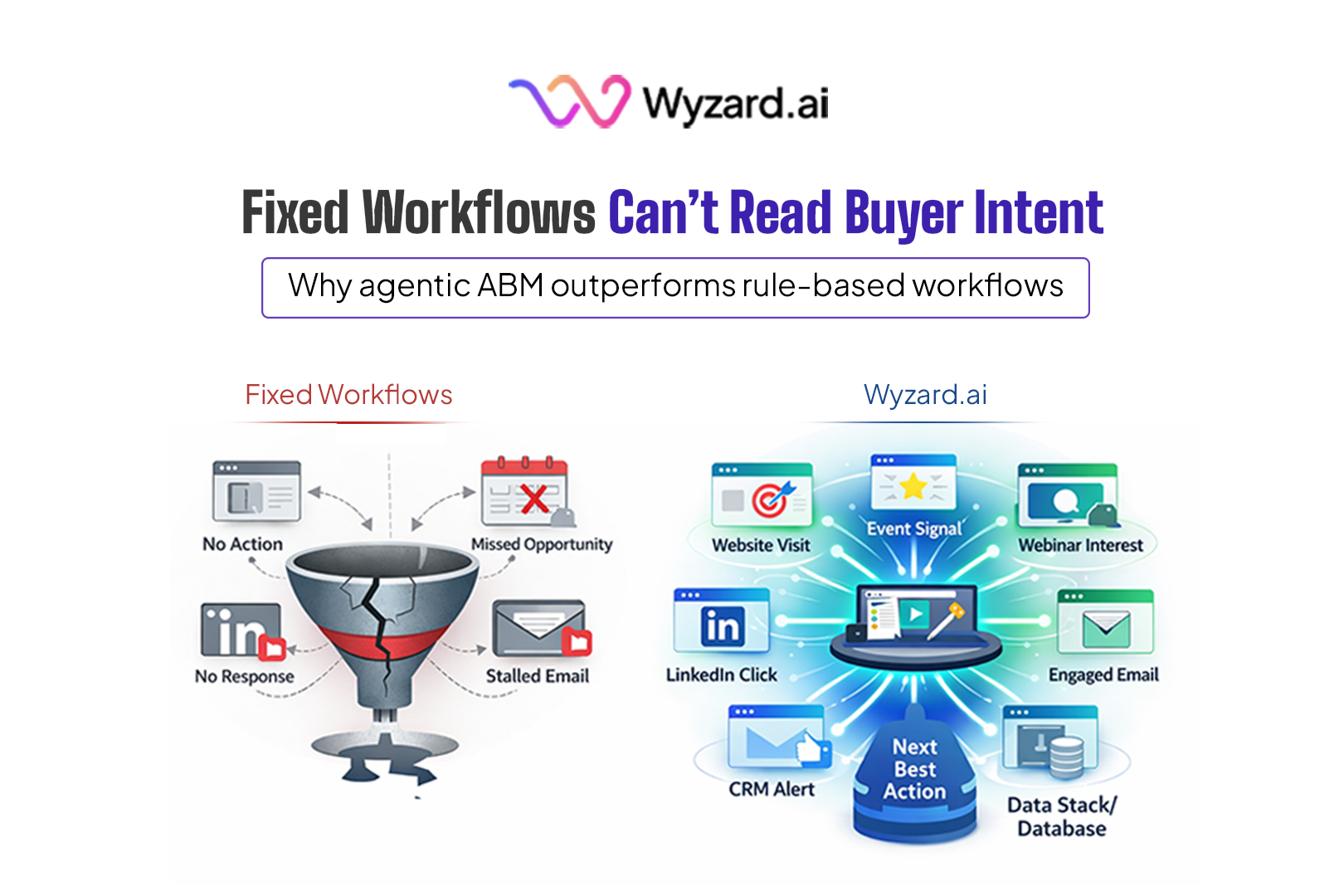
A CMO reviews the weekly pipeline report and sees all the expected activity. A target account visited the website. Someone clicked a LinkedIn ad. A contact from the same company attended a webinar. Another person replied to a nurture email. The stack recorded the activity, yet the account still went quiet. Static workflows can log activity, but they often fail to decide what matters, what it means, and what should happen next. That is where agentic ABM changes the picture. Wyzard, the Signal-to-Revenue AI, was built for this gap. It captures buyer signals as they happen and turns them into coordinated action across channels before intent fades.
This shift is already underway. Deloitte predicts that 25% of enterprises using generative AI will deploy AI agents in 2025, rising to 50% by 2027. GTM leaders have good reason to pay attention. Modern buying journeys do not move in a straight line or stay inside one channel. Buyers move across paid media, events, webinars, email, LinkedIn, CRM activity, and product touchpoints. A system that waits for one trigger and sends one preset sequence is too limited for that reality.
Why ABM automation starts to fall short
Traditional ABM automation still handles repetitive work well. It can route forms, enroll contacts in sequences, and manage simple tasks. Enterprise buying behavior rarely follows a clean script. One account may show light engagement from three stakeholders across four channels, yet no single event hits the threshold that triggers a campaign. A rule-based system sees fragments. A modern GTM team needs a system that sees the account story.
That is why many programs feel busy but limited. In many teams, account research is manual and can take 4 to 6 hours per rep, outreach relies on templates, and the first intelligent touch takes 24 to 72 hours. In the agentic ABM model, research happens in seconds, signals are scored and placed in context, personalization reflects role, intent, and funnel stage, and the first intelligent touch can happen in under 5 minutes.
What makes agentic ABM different
The difference is not message volume. Agentic ABM can read context and act on it. In Wyzard’s framework, five capabilities define this model: memory, perception, reasoning, action, and governance. Memory keeps account history active. Perception tracks live signals across channels. Reasoning decides what matters now. Action launches the next step. Governance keeps execution inside clear guardrails and outcome checks. This model matches the way strong GTM operators think and work.
That is why AI agents for marketing are becoming more useful in ABM. A basic workflow can react to one event. An agentic system can decide whether a booth scan matters more after recent site activity, whether a webinar attendee is likely an evaluator or a buyer, and whether the next step should be an email, a LinkedIn touch, a chat interaction, or a sales alert. Wyzard.ai describes this as a signal-first model built on the GTM Intelligence Graph, where signals, identities, and account history live in one shared context layer.
Where the gap shows up in real execution
This gap shows up in research, personalization, and channel choice. In many enterprise teams, reps still spend hours on manual discovery before they can send a relevant note. Account research automation changes that by pulling together buyer signals, firmographic context, and engagement history in one view. WyzSignals captures real-time buyer intent across web, email, LinkedIn, and CRM touchpoints. WyzEnrich adds verified firmographic, technographic, and engagement data for sharper targeting.
The same issue appears in messaging. Rule-based automation tends to rely on tokenized templates. Real-time personalization works differently. It reflects who the buyer is, what they did, which channel they used, and how far along the account appears to be. Wyzard’s product framework ties WyzGoal to plain-language campaign design and WyzChannels to execution across Agentic Chat, Agentic Email, Agentic LinkedIn, with use cases that span events, webinars, email marketing, website visitors, and paid campaigns. The roles it serves are clear too: marketing, sales, growth, and RevOps.
Why CMOs should care now
For a CMO, this is not a technology debate. It is a pipeline and efficiency issue. The real cost of bad automation is not extra clicks or messy workflows. It is missed buying moments. Teams that react to one channel at a time fail to connect the account-level story. A lead scanned at an event, a prospect clicking a LinkedIn ad, a target account attending a webinar, and a stakeholder replying to a nurture email should not live in separate playbooks. Wyzard’s recent thought leadership makes the same point. The GTM gap usually sits between scattered intent and timely action, not lead generation.
That is where the System of Outcomes matters. Wyzard.ai describes it as the operating layer that ties actions to measurable business results, with the GTM Intelligence Graph providing shared context and AI GTM Engineers helping define goals, tune motions, refine qualification logic, and interpret outcomes under human oversight. Agentic ABM delivers more value when attached to outcomes rather than activity.
What agentic ABM looks like in practice
In practice, a signal comes in and the system does more than fire a preset sequence. It decides whether the account deserves attention, checks what else happened recently, chooses the right persona-level message, and activates the right channel mix. That is multichannel orchestration in a practical sense. Wyzard’s platform description connects WyzSignals, WyzEnrich, WyzGoal, WyzChannels, and the GTM Intelligence Graph into one loop that captures intent, builds context, qualifies readiness, and executes the next best action with human oversight.
The takeaway is simple. Agentic ABM outperforms rule-based workflows since modern ABM needs more than task execution. It needs judgment, timing, channel awareness, and accountable action. Wyzard, the Signal-to-Revenue AI, brings that together to keep the motion aligned with revenue goals. Want to see it in action, book a demo.