How Agentic ABM Aligns Marketing, Sales, and RevOps Around the Same Account Story
A CMO sits in a pipeline review meeting and hears three different interpretations of the same account.
Marketing believes the account is highly engaged. Several stakeholders attended a webinar, interacted with LinkedIn campaigns, and visited key pages on the website. Sales is less convinced. The team sees little direct engagement in active conversations and questions whether the account is actually ready to buy. RevOps points to incomplete CRM records, inconsistent ownership, and fragmented data spread across multiple systems.
This situation is remarkably common.
The issue is rarely effort. It is rarely intent. More often, it is visibility. Every team is looking at the same account through a different lens, using different data, different systems, and different definitions of readiness.
This is where agentic ABM alignment changes the conversation.
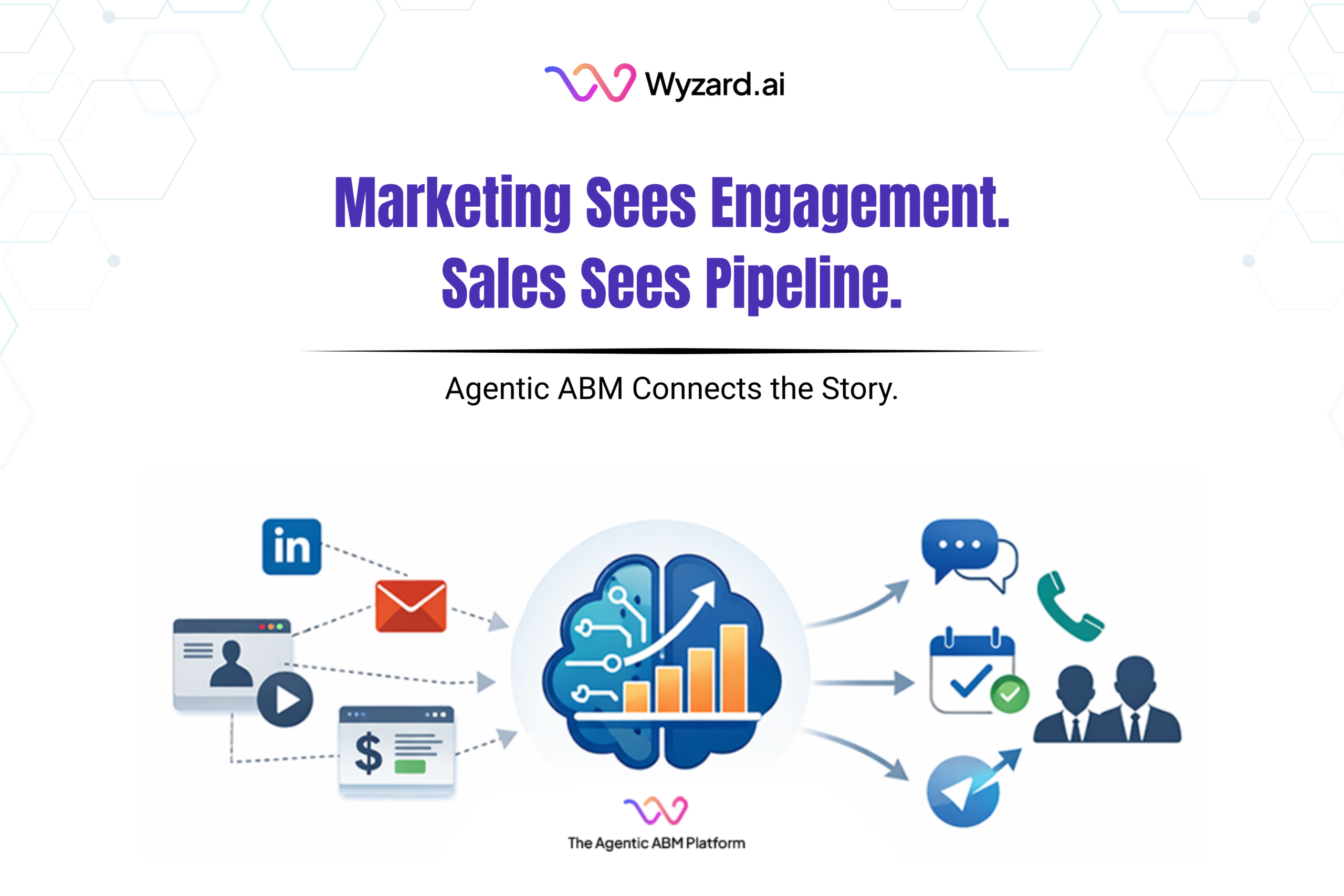
Wyzard.ai, the Agentic ABM platform, was built around a simple idea: revenue teams perform better when they operate from the same account narrative. Instead of separating signals by department or channel, Wyzard.ai connects them into a shared operating layer that Marketing, Sales, and RevOps can trust.
Why traditional ABM often creates internal friction
Most organizations have spent years investing in technology. Marketing automation platforms manage campaigns. CRM systems track opportunities. Sales engagement platforms support outreach. Event systems collect attendee data. Intent tools generate alerts. Analytics platforms generate reports.
The problem is not the lack of information.
The problem is that information rarely comes together in a meaningful way.
A prospect may click a LinkedIn ad, attend a webinar, reply to a nurture email, and visit a pricing page within the same month. Each interaction represents a meaningful signal. Yet those signals often remain trapped inside separate tools. Marketing sees campaign engagement. Sales sees only a portion of the activity. RevOps spends time reconciling records and workflows.
The account is generating buying behavior, but nobody sees the complete picture.
As a result, teams often spend more time debating lead quality, ownership, and readiness than acting on opportunities.
This challenge has become more pronounced as enterprise buying has grown more complex. Most purchase processes are difficult or complex, and when multiple stakeholders, channels, and interactions influence a deal, fragmented visibility becomes a serious obstacle to growth.
Alignment starts with a shared account story
The strongest GTM organizations do not align around leads. They align around accounts.
That sounds obvious, yet many revenue teams still operate through disconnected workflows. Marketing focuses on engagement. Sales focuses on conversations. RevOps focuses on process efficiency. Each function optimizes its own objectives, often without a complete view of what the account is actually doing.
True agentic ABM alignment starts with a shared understanding of account activity.
This means everyone sees the same signals, the same history, and the same context.
A website visit is no longer just a website visit. A webinar registration is no longer an isolated event. A LinkedIn interaction is no longer disconnected from an email reply that happened two weeks earlier.
When these activities are connected, they become part of a larger account story.
That story creates stronger GTM alignment because every team is working from the same source of truth.
Context matters more than activity
One reason traditional ABM struggles with alignment is that activity alone does not explain intent.
A pricing-page visit from an unknown visitor may indicate early interest. A pricing-page visit from an account that attended a webinar, engaged with multiple campaigns, and recently responded to an email tells a very different story.
Without context, signals are easy to misinterpret.
This is where the GTM Intelligence Graph plays a critical role. Wyzard.ai uses the GTM Intelligence Graph to connect buyers, accounts, engagement history, qualification data, and behavioral signals into a unified account view.
That creates shared account context across the organization.
Marketing understands why an account is being prioritized. Sales understands what happened before the conversation. RevOps understands why a workflow was triggered and how that decision was made.
Instead of operating from fragmented snapshots, every team operates from a connected account narrative.
Sales and marketing alignment becomes much easier
Few topics generate more debate in B2B organizations than lead quality.
Marketing believes an account has demonstrated strong intent. Sales believes the account is not ready. Both teams may be acting on incomplete information.
Research from HubSpot shows that organizations with strong sales and marketing alignment are significantly more likely to achieve revenue growth than organizations operating in silos.
The challenge is that alignment cannot be achieved through meetings alone. It requires shared visibility.
When teams work from the same account narrative, discussions become far more productive. The conversation shifts from whether an account deserves attention to what action should happen next.
That change has a direct impact on execution speed, prioritization, and pipeline creation.
Strong sales and marketing alignment is not simply a cultural goal. It is an operational advantage.
RevOps becomes the connective layer
RevOps often carries the responsibility of connecting systems, enforcing governance, and maintaining process consistency across the revenue organization.
That responsibility becomes difficult when every team sees different account data.
Strong RevOps coordination depends on clear qualification logic, shared visibility, and consistent decision-making. Revenue operations teams need confidence that account routing, prioritization, and execution are based on complete information rather than isolated signals.
Wyzard.ai supports this through WyzSignals, WyzQualify, and WyzPlaybook and WyzChannels.
WyzSignals captures engagement across channels. WyzQualify evaluates readiness. WyzPlaybook identifies the next best action. WyzChannels executes across Chat, Email, LinkedIn, and WhatsApp.
The result is a coordinated GTM motion where every team understands why an action is being taken and what outcome it is intended to drive.
What alignment looks like in practice
Consider a target account over a six-week period.
One stakeholder clicks a LinkedIn ad. Another attends a webinar. A third visits the pricing page. An event attendee enters the CRM. A decision-maker replies to an email campaign. A prospect starts a conversation through Chat.
In most organizations, these interactions would be distributed across multiple systems. Marketing would see campaign engagement. Sales would see limited contact activity. RevOps would see fragmented records requiring manual interpretation.
Wyzard.ai approaches the account differently.
Every signal enters the same account narrative. WyzSignals captures activity. The GTM Intelligence Graph connects context. WyzQualify evaluates readiness. WyzPlaybook determines the next action. WyzChannels activates outreach through the appropriate channel. The System of Outcomes tracks how those actions influence meetings, pipeline creation, and revenue movement.
The account remains the center of the workflow.
Every team sees the same story.
One account story creates better revenue execution
Most GTM organizations do not suffer from a lack of data. They suffer from disconnected interpretations of that data.
Marketing, Sales, and RevOps often work hard to create pipeline, yet each function sees a different version of account reality. That fragmentation slows execution, creates internal friction, and weakens decision-making.
Agentic ABM alignment solves this problem by giving revenue teams a shared account narrative built on signals, context, actions, and outcomes.
Wyzard.ai brings this vision together. Book a demo and see how it helps GTM teams align around one account story and turn fragmented signals into coordinated revenue action.