Why Agentic ABM Needs Memory, Not Just Triggers
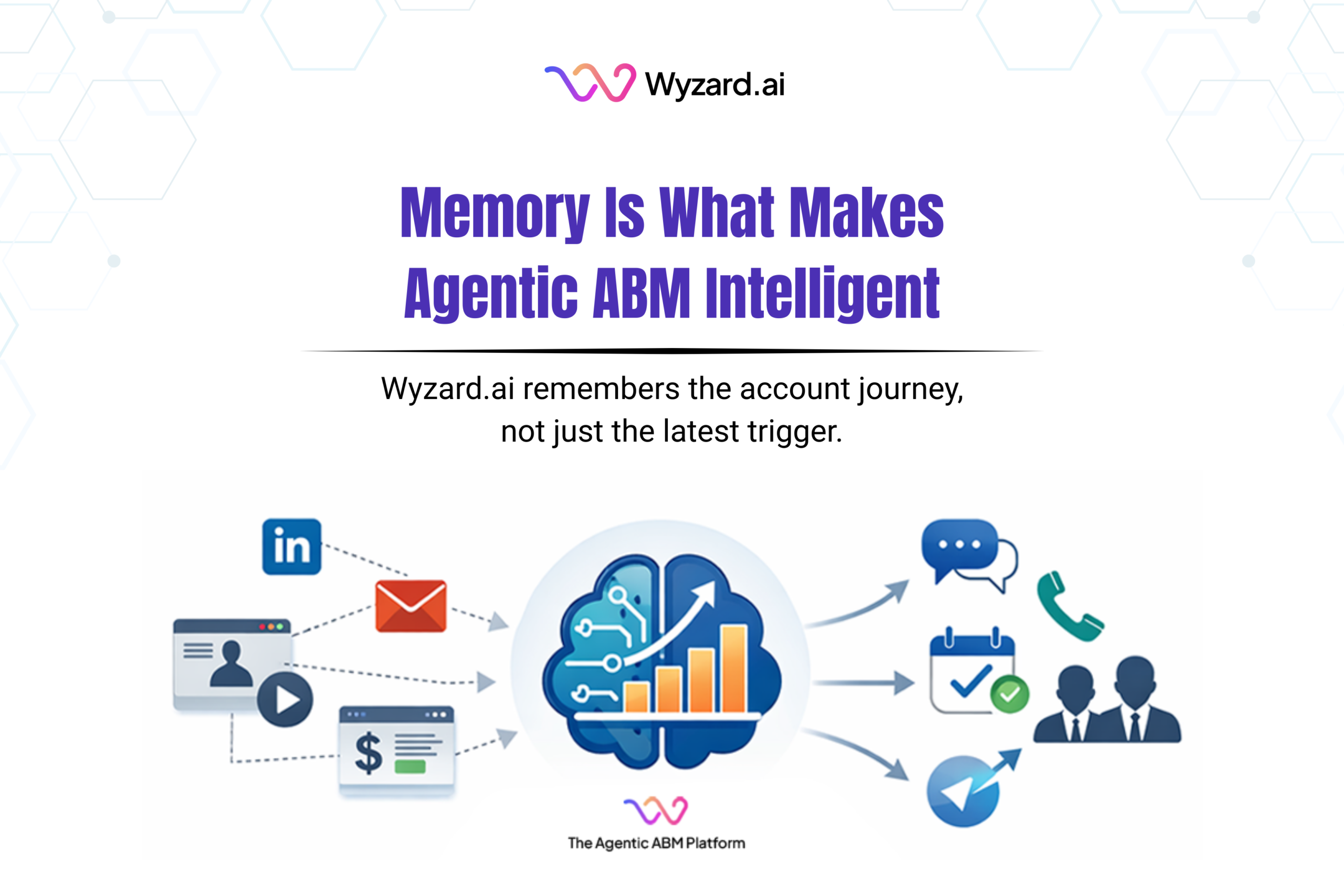
A CMO sees a target account visit the website today. A basic workflow treats it like a fresh event. Send the email. Alert the rep. Move the lead into a sequence.
That same account may have attended a webinar last month, clicked a LinkedIn ad two weeks ago, met your team at an event last quarter, and replied to a nurture email earlier in the buying cycle.
That is why agentic ABM memory matters.
Wyzard.ai, the agentic ABM platform, is built for account continuity. It captures signals across channels, connects them through the GTM Intelligence Graph, and helps teams act with context instead of restarting the conversation every time a new signal appears.
What is agentic ABM memory?
Agentic ABM memory is the ability of an agentic ABM system to retain and apply account history across interactions, stakeholders, channels, and time.
It connects:
- website visits
- event scans
- webinar attendance
- LinkedIn engagement
- email replies
- CRM updates
- qualification decisions
- prior outreach
This gives the system persistent context. A new signal is no longer treated as an isolated action. It is interpreted against everything the account has already done.
That is the difference between basic automation and agentic ABM memory. One reacts. The other remembers.
Why triggers alone fall short
Triggers work for simple motions. Someone fills a form, so a workflow starts. Someone visits a pricing page, so an alert fires.
Enterprise buying rarely happens in single moments.
A trigger can tell you something happened. Agentic ABM memory explains what it means.
Without memory, workflows often:
- treat returning buyers like new leads
- ignore prior engagement
- miss buying group patterns
- repeat the same message
- lose context across channels
That creates poor signal interpretation.
A pricing-page visit from a first-time visitor may mean early interest. A pricing-page visit from a known stakeholder after two webinars and a nurture reply means something very different.
Returning buyers should not start from zero
This is one of the clearest use cases for agentic ABM memory.
A returning buyer may have gone quiet for three weeks. Then they come back after an internal project gets funded, a leadership change happens, or a new pain point appears.
A traditional workflow sees the return visit and starts a generic sequence.
An agentic ABM system with memory sees the full journey:
- what they engaged with before
- which channel they used
- which role they likely play
- what messaging they already received
- what the next useful action should be
That is where buyer context becomes valuable. Wyzard.ai connects web visits, chat engagement, email clicks, trial usage, and CRM updates into one stream of meaning, so teams do not piece together account activity manually.
Long-cycle enterprise deals need continuity
Enterprise deals often move across months, teams, and stakeholders.
One person may attend a webinar. Another may click a LinkedIn ad. A technical evaluator may ask product questions. A senior buyer may respond later through email. Someone else may appear through an event interaction.
Without agentic ABM memory, each touchpoint creates a separate workflow.
With agentic ABM memory, the account journey stays connected.
This matters for buying group continuity. A system needs to remember which stakeholders engaged, what topics mattered, what stage the account seemed to be in, and what action was already taken.
That is what separates persistent GTM execution from short-lived campaign response.
How memory improves signal interpretation
The same signal can mean different things depending on what happened before.
A webinar signup may signal curiosity. A webinar signup after repeated website visits and a LinkedIn click may signal active research. A nurture reply after event attendance may signal readiness for a sales conversation.
This is where agentic ABM memory changes the quality of decision-making.
Instead of asking, “What happened just now?” the system can ask:
“What does this signal mean in the full account journey?”
Where Wyzard.ai fits
Wyzard.ai uses the GTM Intelligence Graph as the memory layer for agentic ABM.
It connects:
- identities
- accounts
- signals
- touchpoints
- timing
- behavioral patterns
- readiness signals
Wyzard.ai’s product set turns that memory into action. WyzSignals captures the activity. WyzEnrich adds missing context. WyzQualify reads intent. WyzPlaybook keeps the system aligned to outcomes. WyzChannels acts through Agentic Chat, Agentic Email, Agentic LinkedIn, or Agentic WhatsApp. WyzGPT supports reasoning and messaging.
Wyzard.ai connects this to the System of Outcomes, where execution is measured against business results instead of activity alone.
That is practical GTM memory in action. For CMOs, this means the team stops losing history every time a buyer changes channel.
What this looks like in practice
Picture one target account.
In March, a stakeholder attends a webinar.
In April, someone clicks a LinkedIn ad.
In May, a lead is scanned at an event.
In June, a known contact revisits the website.
In July, a prospect replies to a nurture email.
Without memory, each event triggers a separate response.
With Wyzard.ai and agentic ABM memory, those signals become one account story.
The system remembers what happened, connects the activity through the GTM Intelligence Graph, evaluates readiness with WyzQualify, defines the motion through WyzGoal, and executes across Chat, Email, LinkedIn, or WhatsApp through WyzChannels.
The result is outreach that feels connected, timely, and useful.
Why CMOs should care
CMOs do not need more disconnected signals. They need better conversion from the demand they already create.
Agentic ABM memory helps teams:
- avoid restarting conversations
- reduce lead leakage
- improve buying group continuity
- support more relevant outreach
- give sales better account context
- build more predictable enterprise pipeline
It turns fragmented activity into a remembered account journey.
Memory is what makes Agentic ABM smarter
Triggers create motion. Memory creates judgment.
That is why agentic ABM memory is more than a technical feature. It is the foundation for long-cycle, multi-stakeholder, omni-channel ABM execution.
Wyzard.ai brings this together through WyzSignals, WyzEnrich, WyzQualify, WyzGoal, WyzChannels, WyzGPT, the GTM Intelligence Graph, the System of Outcomes, and AI GTM Engineers.
Book a demo and see how Wyzard.ai turns account history into smarter agentic ABM execution.